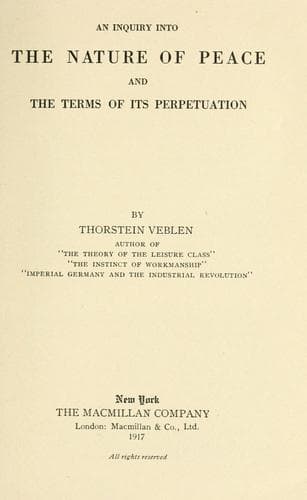
An Inquiry into the Nature of Peace and the Terms of Its PerpetuationVeblen, Thorstein
Philosophy
An Inquiry into the Nature of Peace and the Terms of Its Perpetuation
Veblen, Thorstein
Peace; World War, 1914-1918 -- Peace
As to the limitation imposed by the price-system on the supply of
candidates suited by native gift for the human work of civilisation; it
would no doubt, be putting the figure extravagantly high to say that the
gentlefolk, properly speaking, comprise as much as ten percent of the
total population; perhaps something less than one-half of that
percentage would still seem a gross overstatement. But, to cover loose
ends and vagrant cases, the gentlefolk may for the purpose be credited
with so high a percentage of the total population. If ten percent be
allowed, as an outside figure, it follows that the community's
scientists, artists, scholars, and the like individuals given over to
the workday pursuits of the human spirit, are by conventional
restriction to be drawn from one-tenth of the current supply of persons
suited by native gift for these pursuits. Or as it may also be
expressed, in so far as the projected scheme takes effect it should
result in the suppression of nine (or more) out of every ten persons
available for the constructive work of civilisation. The cultural
consequences to be looked for, therefore, should be quite markedly of
the conservative order.
Of course, in actual effect, the retardation or repression of
civilisation by this means, as calculated on these premises, should
reasonably be expected to count up to something appreciably more than
nine-tenths of the gains that might presumably be achieved in the
conceivable absence of the price-system and the regime of investment.
All work of this kind has much of the character of teamwork; so that the
efforts of isolated individuals count for little, and a few working in
more or less of concert and understanding will count for proportionally
much less than many working in concert. The endeavours of the
individuals engaged count cumulatively, to such effect that doubling
their forces will more than double the aggregate efficiency; and
conversely, reducing the number will reduce the effectiveness of their
work by something more than the simple numerical proportion. Indeed, an
undue reduction of numbers in such a case may lead to the total defeat
of the few that are left, and the best endeavours of a dwindling remnant
may be wholly nugatory. There is needed a sense of community and
solidarity, without which the assurance necessary to the work is bound
to falter and dwindle out; and there is also needed a degree of popular
countenance, not to be had by isolated individuals engaged in an
unconventional pursuit of things that are neither to be classed as
spendthrift decorum nor as merchantable goods. In this connection an
isolated one does not count for one, and more than the critical minimum
will count for several per capita. It is a case where the "minimal dose"
is wholly inoperative.
Public-domain text, read in full here on John Shaqi.
Reviews
Reviews
No reviews yet
Be the first to share your thoughts on this work.
Elsewhere in the archive
Join the Discussion
Join the discussion
Sign in to leave a comment or review.
Sign InorCreate an account