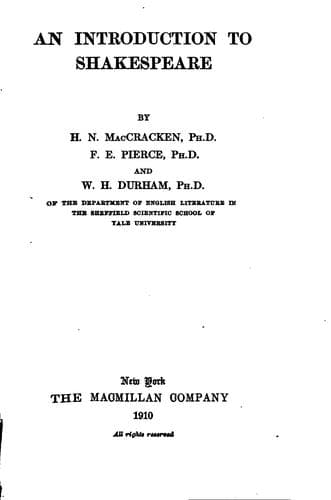
An Introduction to ShakespeareMacCracken, H. N. (Henry Noble)
General
An Introduction to Shakespeare
MacCracken, H. N. (Henry Noble)
Shakespeare, William, 1564-1616 -- Handbooks, manuals, etc.
+Source+.--From Holinshed Shakespeare learned the only actual
historical fact in the play, that one Cunobelinus was an ancient king
of Britain. Cymbeline's two sons are likewise from Holinshed, as is
the rout of an army by a countryman and his two sons; but the two
stories are separate. The ninth novel of the second day of the
_Decameron_ of Boccaccio tells a story much resembling the part of the
play which concerns Posthumus. The play called _The Rare Triumphs of
Love and Fortune_ (1589) contains certain characters not unlike Imogen,
Posthumus, Belarius, and Cloten. Fidelia, Imogen's name in disguise,
is the heroine's name. But direct borrowing cannot be proved.
+The Winter's Tale+.--Nowhere is Shakespeare more lavish of his powers
of characterization and of poetic treatment of life than in this play.
He found for his plot a popular romance of the time, in which a true
queen, wrongly accused of infidelity with her husband's friend, dies of
grief at the death of her son, while her infant daughter, abandoned to
the seas in a boat, grows up among shepherds to marry the son of the
king of whom her father had been jealous. Disregarding the essentially
undramatic nature of the story, as well as its improbabilities, he
achieved a signal {203} triumph of his art in the creation of his two
heroines, and in his conception of the pastoral scenes, so fresh,
joyous, and absolutely free from the artificiality of convention.
In the deeply wronged queen he drew the supreme portrait of woman's
fortitude. Hermione is brave, not by nature, but inspired by high
resolve for her honor and for her children. Nobly indignant at the
slanders uttered against her, her wifely love forgives the slanderer in
pity for the blindness of unreason which has caused his action.
Shakespeare's dramatic instinct made him alter Hermione's death in the
earlier story to life in secret, with poetic justice in store.
Artificial as the long period of waiting seems, before the final
reconciliation takes place, it is forgotten in the magnificent appeal
of the mother's love when the lost daughter kneels in joy before her.
In Perdita, Shakespeare, with incredible skill, depicted the true
daughter of such a mother. Although her nature at first seems all
innocence, beauty, youth, and joy, yet when trial comes to her in the
knowledge that she, a shepherdess, has loved a king's son, and that his
father has discovered it, her courage rises with the danger, and her
words echo her mother's resolution:--
"I think affliction may subdue the cheek,
But not take in the mind."
Public-domain text, read in full here on John Shaqi.
Reviews
Reviews
No reviews yet
Be the first to share your thoughts on this work.
Elsewhere in the archive
Join the Discussion
Join the discussion
Sign in to leave a comment or review.
Sign InorCreate an account