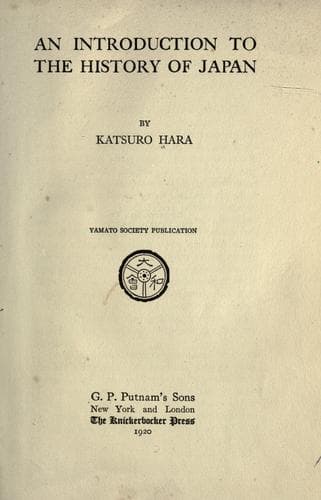
An Introduction to the History of JapanHara, Katsuro
History
An Introduction to the History of Japan
Hara, Katsuro
Japan -- History
As to literature, a difference similar in nature to those
characteristics of the literature of the preceding age can be observed
very distinctly. In the former period, though the essence of the
literature in Japanese was profoundly influenced by the Chinese spirit,
Chinese vocabularies and phrases rarely entered into sentences without
being translated into Japanese. That is to say, the Japanese literature
remained pure as to language, and went on side by side with the
literature in Chinese. Now the combination of the two kinds began to
take form. Chinese words, phrases, and several rhetorical figures began
to be poured into the midst of sentences, the structure remaining
Japanese as before, so that those sentences may be considered as
forming a kind of hybrid Chinese, with words juxtaposed in a Japanese
style, and connected by Japanese participles. This change resulted in
making a great many Japanese words obsolete, and it has since become
necessary for the Japanese constantly to resort to the Chinese
vocabulary in writing as well as in speaking. The growth of Japanese as
an independent language was thus regrettably retarded. At the same time
Japanese literature reaped an immense benefit from this adoption of the
Chinese vocabulary, for by it we became enabled to express our thoughts
concisely, forcibly, and when necessary in a very highflown style,
things not utterly impossible but exceedingly difficult for Japanese
pure in form. The use of Chinese ideographs thus increased from
generation to generation, until now it has become too late to try to
eradicate them. All that which the Japanese nation has achieved in the
past, its history, nay, its whole civilisation, has been handed to us,
recorded in the language, which is woven of Chinese vocabularies and
Japanese syntax, and denoted by symbols which are nothing but Chinese
ideographs and their abbreviations, the Kana. A movement to supersede
the Chinese ideographs by the exclusive use of the _kana_, which are
very simple abbreviations of those ideographs, was initiated at the
beginning of the Meidji era, but was dropped soon afterwards. Another
radical movement to substitute the Roman alphabet for the Chinese
ideographs and the _kana_ in writing Japanese, was started nearly at
the same time, and still continues to have a certain number of zealous
advocates. The success of such a movement, however, depends on the value
of the civilisation already acquired by the Japanese. If that amounts to
nothing, and can be cast aside without any regret, in other words, if
the history of Japan counts for nothing for the present and the future
of the country, then the movement would have some chance of success;
otherwise the attainment of the object is a dream of the millenium.
Public-domain text, read in full here on John Shaqi.
Reviews
Reviews
No reviews yet
Be the first to share your thoughts on this work.
Elsewhere in the archive
Join the Discussion
Join the discussion
Sign in to leave a comment or review.
Sign InorCreate an account