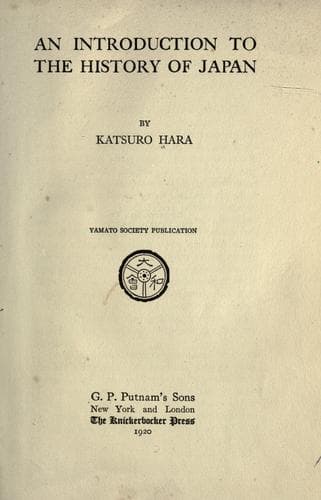
An Introduction to the History of JapanHara, Katsuro
History
An Introduction to the History of Japan
Hara, Katsuro
Japan -- History
Whatever might have been the real motive of Yasutoki and his legal
councillors, the very act of the compilation cannot in itself fail to
betray the consciousness on the part of the Shogunate that it had
already a sufficiency of test cases decided to supply models for the
decision of most of the disputes that might be brought before them in
the future. Or we might say that the Hojo became confirmed in their
belief that the Shogunate was now so firmly established as not to be
easily shaken at its foundation, and that they could henceforth command
in the name of a regular government without any fear of serious
disturbances. Certainly their victory in the civil war must have rid
them of any apprehension of danger from the side of Kyoto.
This compilation was issued in the year 1232, that is to say, about
fifty years after the founding of the Kamakura Shogunate. Thus we can
see that this half-century had wrought an important change in the
history of Japan. During this time the military regime was enabled to
strike a firm root deep into the national life of the Japanese. The
family of the Minamoto soon became extinct by the death of the second
son of Yoritomo, and scions of a Fujiwara noble and then some of the
imperial princes were brought from Kyoto one after another as the
successors to the Shogunate. Yet they were all but tools in the capable
hands of the Hojo family, which remained the real master of the
military government of Kamakura. In course of time, the Hojo also fell,
but other military families successively arose to power, and the
military regime was kept up by them in Japan until the middle of the
nineteenth century. It is true that those changes in the headship and in
the location of the Shogunate caused as a matter of fact corresponding
changes in the nature of the respective military regime. The Shogunate
of the Ashikaga family was of a different sort from that of Kamakura,
while that of the Tokugawa at Yedo was again of another type than the
Ashikaga's at Kyoto. Throughout all these different Shogunates, however,
certain common characteristics prevailed, so that a wide gap may be
discerned between them as a whole and the government of the Fujiwara
courtiers. And those characters indeed have their origin all in this
first half century of the Kamakura Shogunate.
Public-domain text, read in full here on John Shaqi.
Reviews
Reviews
No reviews yet
Be the first to share your thoughts on this work.
Elsewhere in the archive
Join the Discussion
Join the discussion
Sign in to leave a comment or review.
Sign InorCreate an account