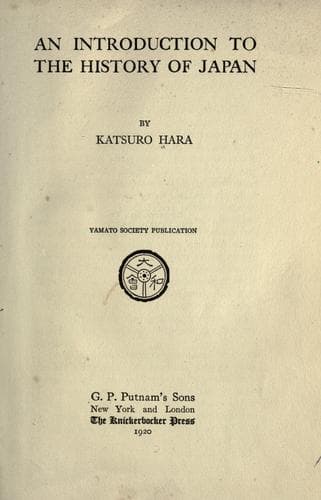
An Introduction to the History of JapanHara, Katsuro
History
An Introduction to the History of Japan
Hara, Katsuro
Japan -- History
It was this regeneration of Japan, which kept up and nourished what was
initiated in the Taira period. But for the Kamakura Shogunate, however,
those germs of the new era might have been blasted forever. One thread
of the continuous development from the Taira to the Minamoto period may
be clearly discerned in the sphere of religion. In 1212 died Honen, the
reformer of Buddhism, of whom I have already spoken in the preceding
chapter, but before his death his teachings had gathered a great many
adherents around him, and the sect of the Jodo became independent of
that of the Tendai. It was from this Jodo sect that the Shinshu or the
"orthodox" Jodo, now one of the most influential Buddhist sects in
Japan, sprang up, and became independent also. Shinran, the founder of
the latter sect, is said to have been one of the disciples of Honen, and
the tenets of his sect, initiated by Shinran himself and supplemented by
his successors, bear striking resemblance to the reform tenets of Luther
in laying stress on faith and in denouncing reliance on the merit of
good works in order to arrive at salvation. That the priests belonging
to this sect have avowedly led a matrimonial life, a custom which was
unique to this sect among Japanese Buddhists, is another point of
resemblance to Lutheranism. In other respects, for example, in preaching
the doctrine of predestination, it can be considered as analogous to
Calvinism also.
Another important sect, which branched off from the Tendai, is that of
the followers of Nichiren. His sect is called the Hokke, or Nichiren,
after the name of the founder himself, and the sect still contains a
vast number of devotees. It is the most militant sect of Buddhism in
Japan, and that militancy might be traced to the personality of
Nichiren, the founder, who was the most energetic and aggressive priest
Japanese Buddhism has ever produced. He, too, never claimed to have
founded a new sect, and insisted that his doctrine was simply a
resuscitated Tendai tenet. We can easily see, however, that in its
pervading tendency it approached other reformed sects of the same age
rather than the old or orthodox Tendai. Nichiren died in the year 1282,
so that his most flourishing period falls in the middle of the
thirteenth century.
Public-domain text, read in full here on John Shaqi.
Reviews
Reviews
No reviews yet
Be the first to share your thoughts on this work.
Elsewhere in the archive
Join the Discussion
Join the discussion
Sign in to leave a comment or review.
Sign InorCreate an account