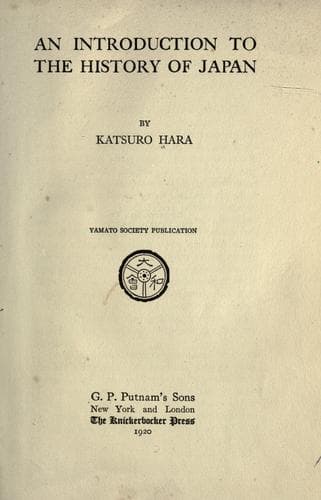
An Introduction to the History of JapanHara, Katsuro
History
An Introduction to the History of Japan
Hara, Katsuro
Japan -- History
To say sooth, the field of activity of those untiring priests was not
restricted to those eastern provinces, which are denoted by the general
appellation of "Kwanto", but was extended into the far northern
provinces of Mutsu and Dewa. This region at the extremity of Honto was
long ago created as provinces, but had lagged far behind the rest of
Japan in respect of civilisation. A considerable number of the Ainu were
still lingering in the northern part of the two provinces.
Fujiwara-no-Hidehira, the generalissimo of the region, who harboured
Yoshitsune, the younger brother and victim of Yoritomo, is said to have
been of Ainu blood. His sphere of influence reached Shirakawa on the
south, which was considered at that time the boundary between civilised
and barbarous Japan. The time had arrived, however, when this barrier
was at last to be done away with. When a quarrel arose between the two
brothers, Yoritomo and Yoshitsune, after the annihilation of the Taira,
and the latter sought refuge with Hidehira, Yoritomo thought of marching
into Mutsu. This expedition was undertaken in the year 1189, after the
death of Hidehira. His sons were easily defeated. The land taken from
them was distributed by Yoritomo among his soldiers, who followed him
from the Kwanto and fought under his banner. The vast region, by coming
thus under the military authority of the Kamakura Shogunate, was for the
first time, taken into Japan proper. It was on account of this extension
of political Japan over the whole of Honto, that the new sects had a
chance to penetrate into those provinces.
We have seen that religion was the first and the most forcible exponent
of the new age. If the Shogunate of Kamakura had remained in power
longer than it did, other factors of the new civilisation might have
developed quite afresh around the Shogunate. Art and literature of
another type than that which flourished at Kyoto might have blossomed
forth. The time was, however, not yet ripe for the total regeneration of
Japan. The conventionalism of the Kyoto civilisation more and more
influenced the Shogunate, which was still too young and had nothing
solid of its own civilisation capable of resisting the infiltration of
the old. Besides, several difficulties which lay in the way of the
Shogunate cooperated in bringing about its fall in the year of 1332.
Japan had to go on in a half regenerated state for some time.
CHAPTER VIII
THE WELDING OF THE NATION
THE POLITICAL DISINTEGRATION OF THE COUNTRY
Public-domain text, read in full here on John Shaqi.
Reviews
Reviews
No reviews yet
Be the first to share your thoughts on this work.
Elsewhere in the archive
Join the Discussion
Join the discussion
Sign in to leave a comment or review.
Sign InorCreate an account