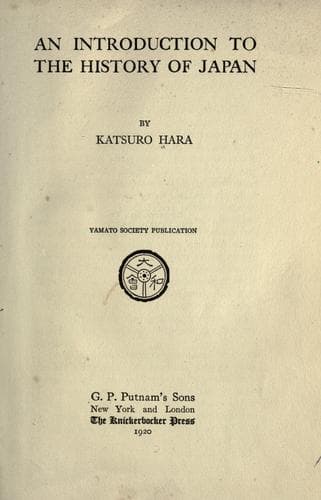
An Introduction to the History of JapanHara, Katsuro
History
An Introduction to the History of Japan
Hara, Katsuro
Japan -- History
Those who were appointed as _djito_ by Yoritomo at the beginning of the
Shogunate had all been retainers of the Minamoto family from the first.
Though they discharged the duties of military police within their
respective manors as if they were public officials, yet their private
character far outweighed their public semblance. As the Shogunate
gradually took the form of a regular government, this private and
personal bond between the Shogun and his retainers grew weaker, and the
public character of the _djito_ began to predominate. This was
especially the case after the virtual management of the Shogunate fell
into the hands of the Hojo family. It is true that those retainers still
called themselves the _go-kenin_, or the domestics of the Shogun of
Kamakura. The later Shogun, however, sprung from the Fujiwara family or
of blood imperial, and could not demand the same obedience which
Yoritomo had found easy to obtain from his hereditary vassals. In
effect, the Shogunate reserved to the end the right of giving sanction
as regards the inheritance of the office of _djito_, but the exercise of
the reserved right was generally nominal. A _djito_ could appoint as his
successor either his wife or any of his children, or could divide his
official tenure among many inheritors. No Salic law and no law of
primogeniture yet existed in Japan of the Kamakura period, so that,
besides many _djito_ who were incapable of discharging the military
duties in person on account of sex or age, there were to be found
eventually a great number of _djito_, whose official tenure covered a
very small patch of ricefield, so small that it was too narrow to
exercise any jurisdiction within it! Moreover, men of utterly unwarlike
professions like priests, and corporations such as Shinto shrines and
Buddhist temples, were also entitled to succeed to the inheritance of
the office of _djito_, if only it were bequeathed to them by a lawful
will. In these cases, where the rightful _djito_ could not officiate in
person, a lieutenant, private in character, used to be appointed. Those
lieutenants, however, not being publicly responsible to the Shogun,
behaved very arbitrarily. That was a breach severely felt in the
military system of the Shogunate.
Public-domain text, read in full here on John Shaqi.
Reviews
Reviews
No reviews yet
Be the first to share your thoughts on this work.
Elsewhere in the archive
Join the Discussion
Join the discussion
Sign in to leave a comment or review.
Sign InorCreate an account