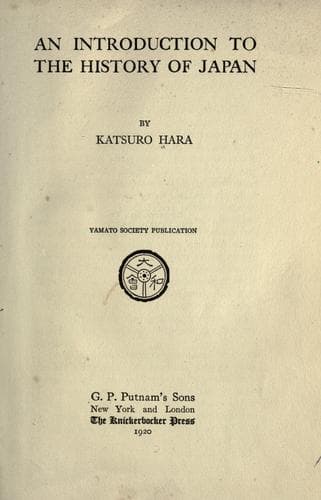
An Introduction to the History of JapanHara, Katsuro
History
An Introduction to the History of Japan
Hara, Katsuro
Japan -- History
suit the new spirit of the new age, that is to say, before the Shogunate
could accomplish its cultural mission in the history of Japan. The
culture of Kyoto proved itself to be omnipotent as ever.
Regarded in this manner, the return of the governmental seat to Kyoto
had a great advantage. The new Shogunate, having located its centre in
the same historical place where the classical civilisation of Japan had
had its cradle also, its military and political organisation could work
hand in hand with the social and cultural movement. The prestige of the
Shogun was bedecked with a brighter halo than when Kamakura had been the
seat of his government. The change, however, was accompanied with
invidious results, ruinous not only to the Shogunate, but to the
political integrity of the country at large.
After having experienced the vicissitudes of a long civil war, the
courtiers became convinced that they could not overthrow by any means
the military regime, which had already taken deep root in the social
structure of our country. So they began to think that it was wiser for
them to make use of that military power than to try any abortive
attempts against it. They heaped, therefore, on the successive Shoguns
of the Ashikaga family titles of high-sounding honour, much higher than
those with which the Shoguns of Kamakura had been invested. In the
imperial palace, too, special deference was paid to the Shogun. Such a
rise in the court-rank of the Shogun induced his retainers to vie with
one another in obtaining some official rank of distinction in the
courtiers' hierarchical scale. Those who belonged to the higher classes
among them, though they were mostly the _shugo_ or military governors of
one or more provinces, used to spend a greater part of their time at
Kyoto, on account of holding some civil office in the government of the
Shogun, and lived in a very aristocratic way, which was easy and
indolent, that is to say, not much different from that of the courtiers.
There were many social meetings, in which both courtiers and warriors
participated together, and the object of these meetings mostly consisted
in enjoying various kinds of literary pastimes, among which the
commonest was a trick in versification called _renga_, that is to say,
the composing by turns of a line of an unfinished poem, which should
form a sequence to the preceding and at the same time become the
prologue to the next. Through manifold channels of this and the like
kinds of amusements, a very intimate relation between the two classes
was cemented. The refinement of the courtiers' circle, though somewhat
vulgarised compared with that of the previous period, freely penetrated
into the families of the rough soldiery. Marriages between members of
the two classes also took place frequently, by which the courtiers
gained materially, while the soldiers could thereby assuage the
uneasiness of their parvenu-consciousness. A new social life thus sprang
up.
Public-domain text, read in full here on John Shaqi.
Reviews
Reviews
No reviews yet
Be the first to share your thoughts on this work.
Elsewhere in the archive
Join the Discussion
Join the discussion
Sign in to leave a comment or review.
Sign InorCreate an account