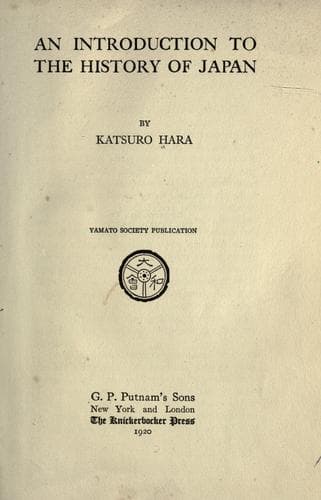
An Introduction to the History of JapanHara, Katsuro
History
An Introduction to the History of Japan
Hara, Katsuro
Japan -- History
family in a time not far distant from that of the Mongolian invasion,
may perhaps be attributed to the influence of some of these priests.
Without doubt the invasion of the Mongolian host put a momentary stop to
this mutual intercourse. It seems, however, that the trade with China
was revived soon after the war, and continued down to the time of the
Ashikaga, without being interrupted materially even by the long civil
war. Far from cessation or interruption, the official intercourse
between the two states which had been broken off for some years was
during this civil war restored to its former amicable condition. It was
while the internecine strife was raging over the whole of the island
Empire, that a change of dynasty took place in China. The Mongols were
driven away to their original abode in the desert, and in their place
reigned in China the new dynasty of the Ming, founded by a general of
Chinese blood. This founder of the Ming sent an embassy to Japan to
announce the inauguration of his line and to secure the coast of his
empire from inroads and pillage by Japanese pirates, who, since several
centuries, had been ravaging the Korean and then the Chinese coast, and
became especially rampant during the civil war, being let loose by the
unexampled lawless state of our country. The ambassador of the Chinese
emperor, however, could not at once reach Kyoto, which was his
destination. For at that time in Kyushu ruled an imperial prince who was
a scion of the branch antagonistic to that which reigned in the
metropolis supported by the Ashikaga, and the prince-governor, as he was
then the master of the historic trading port of Hakata, intercepted the
Chinese ambassador on his way, received him, and sent him back. This
happened in the year 1369. Seven years afterwards this very prince sent
an envoy to the Chinese government, perhaps with the object of obtaining
some material assistance from beyond the sea, in order to make himself
strong enough to overpower his enemy in Japan, the Ashikaga party. As
the sender was a prince of the blood imperial, the envoy sent by him
seems to have been regarded as if he were the representative of the real
government of Japan, and the intercourse between the two countries thus
began to take official form again. When the civil war ended in the
ultimate victory of the Ashikaga party and the annihilation of all its
opponents, this international relation initiated by the prince of Kyushu
was taken up by Yoshimitsu, the third Shogun of the Ashikaga, who sent
an embassy to the Chinese government of the Ming in the year 1401. After
this we see successive exchanges of embassies between the Chinese
government and our Ashikaga Shogunate, the latter vouchsafing the
orderliness of our trading people on the Chinese coast and promising to
bridle the piratical activities of our adventurers, and the former
giving in return munificent presents to the Shogunate. At that time what
Public-domain text, read in full here on John Shaqi.
Reviews
Reviews
No reviews yet
Be the first to share your thoughts on this work.
Elsewhere in the archive
Join the Discussion
Join the discussion
Sign in to leave a comment or review.
Sign InorCreate an account