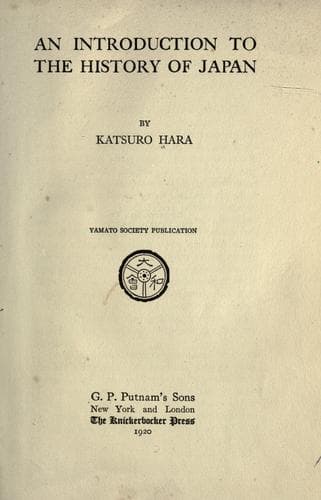
An Introduction to the History of JapanHara, Katsuro
History
An Introduction to the History of Japan
Hara, Katsuro
Japan -- History
It was natural, therefore, that, after the civil war of the Ohnin era,
Sakai should be considered safer to live in than Kyoto. Sakai became the
asylum for the civilisation of Japan, to save it from utter destruction.
Poets, painters, musicians, and singers, who had found living in the
turbulent metropolis intolerably hard, sought shelter in Sakai, and
there occupied themselves quietly with their own professions. Various
handicrafts, such as lacquering, porcelain-making, and weaving were all
started there with enormous success. Especially as to the weaving, it is
said that this industry, which had once flourished and been afterwards
abandoned in Kyoto on account of the political disturbances there, was
not only continued at Sakai, but also improved by the Chinese weavers,
who repaired to the city and taught the natives the art of making
various costly textiles of Chinese invention. In some respects the
textiles of the Nishijin, now one of the specialties of Kyoto, may be
said to be the continuation of the Sakai looms.
Another kind of industry, which developed in the city in the later
Ashikaga period, was the manufacture of fire-arms. Immediately after the
introduction of fire-arms by a Portuguese in the year 1541, a merchant
of Sakai happened to learn the art of making guns somewhere or other in
Kyushu, and after his return to the city he began to practise there the
business he had learnt. Sakai thus became the origin of the propagation,
in central and eastern Japan, of the use of the new arm.
From what has been described above, the reader would easily understand
that the intellectual level of the citizens of Sakai stood much higher
than that of the average Japanese of that time. Wit and pleasantry were
the accomplishments highly prized there, so that the city produced out
of its inhabitants a large number of versatile diplomatists,
story-tellers, and buffoons. As their economic conditions were very
easy, the social life of the city was polished, enlightened, and even
luxurious. The manufacture of sake, the Japanese favourite drink made
from rice, was highly developed in the city, and the fame of the
Sakai-tub was renowned the country round. To protect the brewers, the
Shogunate issued an order forbidding the importation of sake into the
city. The tea-ceremony and the flower-trimming, two fashionable pastimes
already in vogue at that time, were eagerly practised here by wealthy
merchants. Many famous experts in this sort of amusement were found
among the inhabitants of the city, and they were generally connoisseurs
highly skilled in the fine arts, as Sen-no-Rikyu, for example. Various
curios, native and foreign, were bought and sold there at exorbitant
high prices.
Public-domain text, read in full here on John Shaqi.
Reviews
Reviews
No reviews yet
Be the first to share your thoughts on this work.
Elsewhere in the archive
Join the Discussion
Join the discussion
Sign in to leave a comment or review.
Sign InorCreate an account