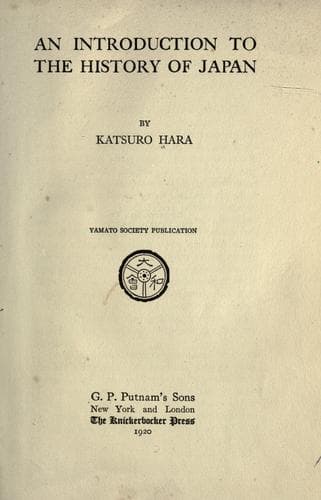
An Introduction to the History of JapanHara, Katsuro
History
An Introduction to the History of Japan
Hara, Katsuro
Japan -- History
In order to achieve the national unification and to effect the
modernisation of the country, it was necessary to dispense with all the
red tape, the time-honoured superstitions and all other encumbrances
lying in the way. It was not, however, an easy task to do away with all
these things, for they had been held sacrosanct, so that to set them at
defiance was but to brave the public opinion of the time. And none had
been courageous enough to raise his hand against them, until Nobunaga
decided to rid himself of all these feeble but tenacious shackles.
In the year 1571 Nobunaga attacked Mount Hiyei, for the turbulent
shavelings of the mountain had sided with his enemies in the war of the
preceding year, and burned down the Temple Yenryakuji to the ground. The
emblem of the glory of Buddhism in Japan, which had stood for more than
seven centuries, was thus turned to ashes. The next blow was struck at
the recalcitrant priests of the temple of Negoro, belonging to the same
sect as Koya and situated near it. As for the Ikko-sectarians with the
Hongwanji as centre, the arms of Nobunaga were not so successful against
them as against the other two temples, so that in the end he was
compelled to conclude an armistice with them, but he was able in great
measure to curtail their overbearing power. Of all these feats of arms,
the burning of the temples on Mount Hiyei most dumbfounded Nobunaga's
contemporaries, for the hallowed institution, held in the highest esteem
rivalling even the prestige of the Imperial family, was thus prostrated
in the dust, unable to rise up again to its former grandeur. It is much
lamented by later historians that in the conflagration of the temple an
immense number of invaluable documents, chronicles and other kinds of
historical records was swept away forever, and they calumniated our hero
on this account rather severely. It is true that if those materials had
existed to this day, the history of our country would have been much
more lucid and easy to comprehend than it is now, and if Nobunaga could
have saved those papers first, and then burnt the temple, he would have
acted far more wisely than he did, and have earned less censure from
posterity. But history is not made for the sake of historians, and we
need not much lament about losses which there was little possibility of
avoiding. A nation ought to feel more grateful to a great man for giving
her a promising future, than for preserving merely some souvenirs of the
past. The bell announcing the dawn of modern Japan was rung by nobody
but Nobunaga himself by this demolition of a decrepit institution.
Public-domain text, read in full here on John Shaqi.
Reviews
Reviews
No reviews yet
Be the first to share your thoughts on this work.
Elsewhere in the archive
Join the Discussion
Join the discussion
Sign in to leave a comment or review.
Sign InorCreate an account