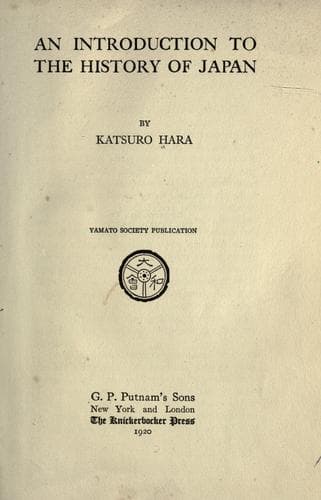
An Introduction to the History of JapanHara, Katsuro
History
An Introduction to the History of Japan
Hara, Katsuro
Japan -- History
It was in 1582 that Nobunaga died in Kyoto, and in the quarrel which
ensued after his death among his Diadochi, Hideyoshi remained as the
final successor. The year after, Osaka was chosen as the place of his
residence. He was of very low origin, so that he had even less footing
in the conventional old regime than his master Nobunaga, and therefore
was more fitted to become the creator of the new Japan. He continued the
course of conquest begun by Nobunaga, and annexed the whole of historic
Japan within eight years from his accession to the political power. The
most noteworthy item in his internal administration was the land survey
which he ordered to be undertaken parallel to the progress of his arms.
The great estates of Japan were one after another subjected to a uniform
measurement, and thus was fashioned the standard of new taxation. This
land-survey began in 1590 and continued till the death of Hideyoshi. The
proportion of the tax levied to the area of the taxable land must still
have varied in different localities, but the mode of taxation was now
simplified thereby to a great extent, for the old systems, each of which
was peculiar to an individual estate, were henceforth mostly abrogated.
The manorial system of old Japan was entirely swept away.
The unity of the nation under Hideyoshi, that is to say, Japan at the
disposal of a single person, an illuminated despot, might have been
really the result of the long process of unification gradually
accentuated, but it may also be considered as one of the causes which
brought about a still stronger national consciousness. The expulsion of
the foreign missionaries and the prohibition of the Christian propaganda
did not constitute a religious persecution in its strict sense. That
Hideyoshi was no enthusiastic Buddhist should be accepted as a negative
proof of it. Most probably he had no religious aversion against
Christianity, but the intermeddling of those missionaries in the
politics of our country infuriated him, for the demand for the solid
unification of the nation, embodied in him, was against such an
encroachment. The persecution, which crowned many adventurers with the
honour of martyrdom, is to be imputed to the lack of prudence on the
part of those missionaries.
As to the motive of the Korean invasion undertaken by Hideyoshi, various
interpretations have been put forth by various historians. Some explain
it as mere love of adventure and fame. Others attribute it to the
necessity of keeping malcontent warriors engaged abroad, in order to
keep the country pacific. As Hideyoshi himself died while the expedition
was still in progress, giving neither explanation nor hint of his real
motive, it is very difficult for us to fathom his innermost thought. It
would not be altogether a mistaken idea, however, if we consider it as
an outcome of his unifying aspiration carried a few steps farther
outside the empire.
Public-domain text, read in full here on John Shaqi.
Reviews
Reviews
No reviews yet
Be the first to share your thoughts on this work.
Elsewhere in the archive
Join the Discussion
Join the discussion
Sign in to leave a comment or review.
Sign InorCreate an account