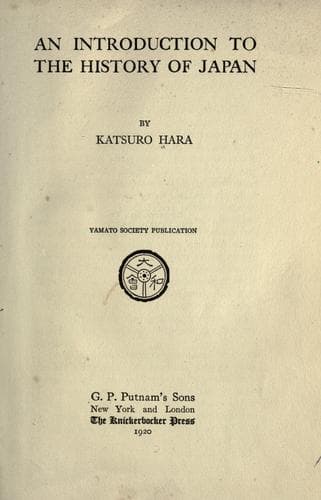
An Introduction to the History of JapanHara, Katsuro
History
An Introduction to the History of Japan
Hara, Katsuro
Japan -- History
In the foregoing chapter I spoke about some resemblances between our
later Ashikaga period and the Italian renaissance of the Quattrocento.
In the successive phases which followed in the East and in the West,
there might be found some other similarities. History, however, has not
been ordained to run in streams exactly parallel to one another in all
countries, and to be a counterpart of the age of the Reformation, the
epochs of the Oda and the Toyotomi are not more appropriate than the age
of the Kamakura Shogunate. A style in Japanese art, prevalent during and
after the regime of Hideyoshi and called "the Momoyama" by recent
connoisseurs had a striking resemblance to the Empire style, which
followed the Rococo in Europe, and in some respects indeed the later
Ashikaga period of our history might be likened to Europe of the
eighteenth century, without gross inappropriateness, while at other
points it might be compared to the Renaissance with equal fairness. It
would be very stupid, however, to surmise that Japan in the Tokugawa
period attained to a culture which in its general aspect belonged almost
to the same stage as that prevailing in Europe in the early nineteenth
century. Art, though an important cultural factor, cannot be made the
sole criterion of the civilisation of any nation or people. It is quite
indisputable that Japan under the Tokugawa Shogunate had many things
about which we could not boast.
So long as war is a calamity unavoidable in this world, it is folly to
expect in any country that the cruelty of men to men will entirely
cease. But if the intensity of cruelty in warfare be taken as being in
inverse ratio to the progress of civilisation, as it generally used to
be, then the Tokugawa period evidently should not be lauded as an age of
great enlightenment. Until the end of the Shogunate of this house it had
been the custom for a warrior on the battlefield to cut off the head of
the antagonist whom he had slain. Though we have had no such
demoralising sort of warfare in our history as that carried on by
mercenary troops in medieval Europe, where defeated warriors were taken
prisoners in order to obtain from them as rich ransoms as they could
afford to pay, in other words, though the nature of warfare in Japan was
far more serious in general than in the West, it was on that account far
more dangerous for the combatants engaged. It was the custom in any
battle to reward that warrior who first decapitated an enemy's head as
generously as one who was the first over the wall in an attack on a
fortress. Moreover, during the ceremony in celebration of a victory on a
battlefield, all those enemy heads were collected and brought for the
inspection of the commanding general of the victorious army. Such a
custom in warfare, however efficient it might have been in stimulating
the martial courage of warriors, cannot be regarded as praiseworthy in
any civilised country, even where war is considered as the highest
occupation of the people.
Public-domain text, read in full here on John Shaqi.
Reviews
Reviews
No reviews yet
Be the first to share your thoughts on this work.
Elsewhere in the archive
Join the Discussion
Join the discussion
Sign in to leave a comment or review.
Sign InorCreate an account