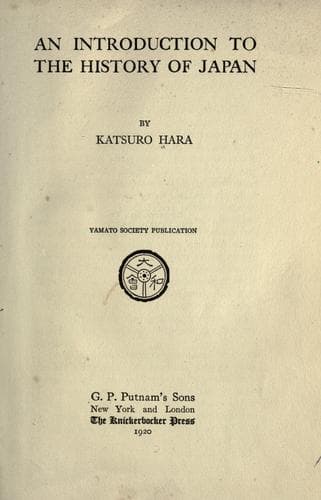
An Introduction to the History of JapanHara, Katsuro
History
An Introduction to the History of Japan
Hara, Katsuro
Japan -- History
Not only such illustrious personages as the above-mentioned Emperors,
Shogun, and eminent warriors, but men of mediocre means or of
unpretentious rank, such as _samurai_, priests, literati and merchants,
also vied with one another in publishing new and old books of Japan as
well as of China, by the method of woodblocks or of movable types. Among
wealthy merchants the most renowned at that time as the Mecaenas of arts
and learning was Yoichi Suminokura. He was born of a rich family living
in a suburb of Kyoto, and was himself an enterprising merchant.
Moreover, his accomplishments in the Chinese classics and in Japanese
versification were far ahead of the average literati of the time, and
his skill in calligraphy has been said to be almost incomparable. Out of
the immense fortune which he had amassed by trading with continental
countries as far as Tonkin and Cochin-China, he spent great sums freely
in publishing books, the greater part of which were works famous in
Japanese literature. It is said that more than twenty sorts of books
were issued by him alone, counting in all several hundred volumes.
What most attracts our attention in his undertakings, however, is the
fact that all of these books were printed, not in the movable type then
in vogue, but in the wood-block style of old. The new method of printing
with type, though introduced several years back and assiduously
encouraged by many influential persons, had not been able to demonstrate
its advantages to the full. In each edition, whoever might have been the
publisher, the number of copies issued had generally not exceeded two
hundred, and that the number was so small shows at the same time the
narrowness of the reading circle of that age. It proves also that Japan
was not yet in any urgent need of seeing books suddenly multiplied by
the busy use of movable types. Moreover, many inconveniences, not known
in the typography of the West, manifested themselves in the adoption of
the new method in a country like the Japan of that time, where Chinese
ideographs had been used almost exclusively as the necessary vehicle for
expressing thought. We had to provide a great variety of fonts of types,
each type-face representing a special ideograph, so that a far larger
and more varied assortment of fonts was required than in the case where
an alphabet is in use, not to mention that the total number of types had
to be enormously augmented out of the necessity of having numerous
multiples of the same type. To print sundry accessories alongside
Chinese texts, in order to make them easily legible for Japanese
students, was another difficulty which was found almost insuperable in
the adoption of movable types. The desire of some editors to insert
illustrations could not also be fulfilled easily, if the text was to be
printed in type, for setting the blocks together with type was
considered a very irksome business at a time when printing in type was
still in its infancy.
Public-domain text, read in full here on John Shaqi.
Reviews
Reviews
No reviews yet
Be the first to share your thoughts on this work.
Elsewhere in the archive
Join the Discussion
Join the discussion
Sign in to leave a comment or review.
Sign InorCreate an account