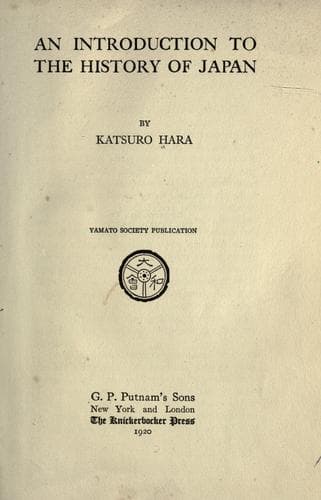
An Introduction to the History of JapanHara, Katsuro
History
An Introduction to the History of Japan
Hara, Katsuro
Japan -- History
Quite contrary to _samurai_ usage, those people below them in rank held
with the _daimyo_ of the territory in which they lived a relationship
which was purely public in character. Socially they were treated as men
beneath the _samurai_, and they themselves were content to be treated as
such. As a class, however, they had no personal relations with the
_daimyo_, unless through the _samurai_, to whom the usufruct of the land
which they cultivated had been allotted by the _daimyo_. In other words,
their duty to their territorial lord was nothing but that which they
owed as a people governed to a governor who chanced to rule hereditarily
over the territory, but might at any time be displaced by somebody else
at the pleasure of the Shogunate. Fidelity on their part to the
_daimyo_, therefore, was no personal obligation, nor the result of a
reciprocal contract, but only a product of a long history, if any
example of such virtue were exhibited. They had no need to follow their
_daimyo_ as his _samurai_ used to do, whithersoever he might be
transferred. On the contrary, all of them remained as a rule in the old
territory, in which they continued for long years to pursue their
business, and welcomed the newly-appointed _daimyo_. In this respect
they might be said to have been much more fixed to the territory than
the _samurai_. At the same time, as their relations with the _daimyo_
were not very close, their movements were not so vigilantly watched as
those of the _samurai_, and during the Tokugawa period, there went on
incessant goings and comings of the lower order in and out of various
territories, though very insignificant in character and therefore
apparently unnoticed. Summarily speaking, the boundary of the
territories of the _daimyo_ was of no practical value in restricting the
population within its geographical pale, in spite of the fact that all
_daimyo_, without exception, exercised their right of scrutinising the
ingress and egress of travellers at certain fixed barriers on the
boundary line. Viewed from the standpoint of the internal migration of
people of all classes, Japan was far from being an agglomeration of
isolated territories. No wonder that the contemporary culture, springing
up from whichever of the three possible sources, could not remain
secluded within the confines of particular localities, but gradually
permeated the country in every direction, and became one.
Public-domain text, read in full here on John Shaqi.
Reviews
Reviews
No reviews yet
Be the first to share your thoughts on this work.
Elsewhere in the archive
Join the Discussion
Join the discussion
Sign in to leave a comment or review.
Sign InorCreate an account