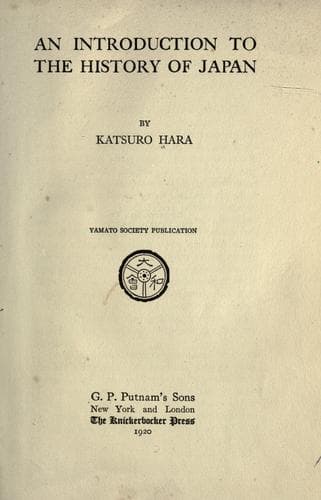
An Introduction to the History of JapanHara, Katsuro
History
An Introduction to the History of Japan
Hara, Katsuro
Japan -- History
The great political change which took place in the year 1867-1868 is
generally called the Restoration, in the sense that the imperial power
was restored by this event. In truth, however, the prerogative of the
Emperor has never been formally usurped, and none has dared impudently
to declare that he had assumed the power in His Majesty's stead. All the
virtual potentates, court-nobles as well as Shogun, who, each in his
day, held unlimited sway over the whole country, had been accustomed to
style themselves modestly vicegerents of the Emperor. On the other hand,
the change was more than a mere restoration, for never in the course of
our national history had the resplendent grandeur of the Imperiality
reached the height in which it now actually stands. In this respect the
Restoration of the Meidji can by no means be taken in the same sense as
the two Restorations famous in European history, that of the Stuarts in
1660 and of the Bourbons in 1814. Renovation, perhaps, would be a more
adequate term to be used here than Restoration, to designate this
epoch-making event in our history. We have reconstructed new Japan from
the old materials, the origins of some of which are lost in remotest
antiquity.
If, however, we should consider the range and intensity of the momentous
change which was caused by the overthrow of the Tokugawa Shogunate, it
is rather a revolution than a renovation. Just the same kind of
disjunction which can be perceived in the transition of France from its
ancient regime to the Revolution may also be noticed in the Japanese
history of the transition period, which divides the pre-Meidji regime
from the present status. The difference is that we accomplished in five
years a counterpart, though on a much smaller scale, of what they took
in France nearly a generation to conclude; a difference which may be
accounted for by the absence in our country of many circumstances which
helped to make the French Revolution really a great historical event.
That those circumstances were lacking in our history, however, is by no
means the fault of our nation. No impartial foreign historian would
grudge a few words of praise to the Japanese who achieved the historic
thorough transformation of national life with little or no bloodshed,
when they think of the tremendous difficulties which Bismarck had to
encounter in his grand task of forming the new German empire, and which
even he himself could not overcome entirely.
Public-domain text, read in full here on John Shaqi.
Reviews
Reviews
No reviews yet
Be the first to share your thoughts on this work.
Elsewhere in the archive
Join the Discussion
Join the discussion
Sign in to leave a comment or review.
Sign InorCreate an account