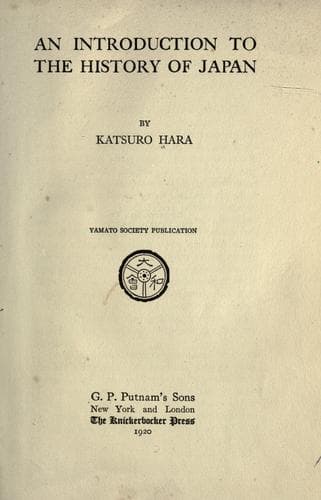
An Introduction to the History of JapanHara, Katsuro
History
An Introduction to the History of Japan
Hara, Katsuro
Japan -- History
The torch, however, which had succeeded in giving blissful light to
illumine the whole nation, burned at last the torch-bearer himself with
its blazing flame. Not to mention that the finances of the territorial
lord had been miserably drained by this undertaking, which is said to
have swallowed up about one-third of the whole revenue of the territory,
and therefore proved too heavy a burden for the small income of the
lord. Narrow-mindedness, which is the necessary consequence of rigorism,
tended to nurture an implacable party spirit among the _samurai_ of the
territory educated in this principle. Internal strife thus ensued which
implicated not only the whole _samurai_ but people of all classes. In
short, the territory was divided against itself. Both parties appealed
to arms at last, and fought against each other, until both had to lie
down quite exhausted. So the culture which the historians and the
_samurai_ of Mito raised to a high pitch proved to be disastrous to
their own welfare, yet the good which it did to the country at large
should remain as a glory to those who sacrificed themselves for what
they regarded as their ideal.
We see now that several forces had cooperated in accomplishing the final
unity and consolidation of the nation. In giving the finishing touch,
however, to the task of many centuries, the enigmatic relations between
the Emperor and the Shogun had necessarily to be cleared. Though the
Shogunate had continued to transact the state affairs as if he had been
the sole regent of the Emperor, the legal status of the former had never
been created by any ordinance issued by the latter. No emperor had ever
formally confided his political prerogative to the Shogun. The basis on
which the jurisdictional power of the Shogun had rested was nothing but
the _fait accompli_ connived at and acquiesced in by the Emperor. If the
prestige of the Emperor, therefore, which had once fallen into
decadence, should be revived, the position of the Shogun was sure to
become untenable. The historians of the Mito school tried their best to
make the Emperor the nucleus of the national consolidation. Their
political theory had been strongly influenced by the legitimism
entertained by the historians of the Sung dynasty, and this principle of
legitimacy, when applied to the history of Japan, must have led only to
the conclusion that the only legitimate and therefore actual sovereign
of the country could be none other than the Emperor himself. Needless to
say, such an argument was injurious to the political interests of the
Shogunate, so that it seems very strange that the theory had been upheld
and loudly heralded by these historians who were under the protection of
the lord of Mito, the descendant of a scion of Iyeyasu. It was not, of
course, the intention of the hereditary lords of Mito and their
historians to undermine the structure of the Shogunate from its
foundation. Having been, however, too sharp and fervent in their
Public-domain text, read in full here on John Shaqi.
Reviews
Reviews
No reviews yet
Be the first to share your thoughts on this work.
Elsewhere in the archive
Join the Discussion
Join the discussion
Sign in to leave a comment or review.
Sign InorCreate an account