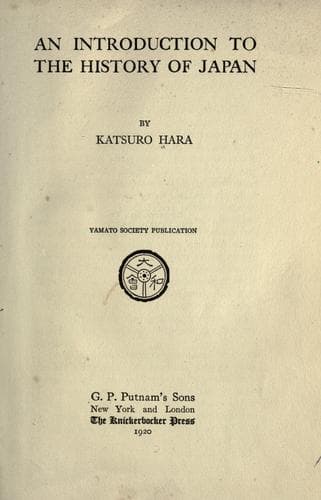
An Introduction to the History of JapanHara, Katsuro
History
An Introduction to the History of Japan
Hara, Katsuro
Japan -- History
land-system of the Teutons. The introduction of the elaborate
organisation of the T'ang dynasty into our country may be interpreted in
two ways. It may be assumed that a land-distribution similar to that of
the Chinese had already existed in Japan, and that this facilitated the
introduction of the foreign methods, which were of the same type but
more highly developed, or we may deny the previous existence of any such
arrangement in our country, reasoning from the fact that the newly
introduced foreign system could not take deep root in our country on
account of its incompatibility with native traditions. What, however, we
can state with some degree of certainty concerning the early history of
Japan, prior to the introduction of Chinese institutions, is that the
people, or rather groups of people, figured in the social system as
objects of possession quite as much as did landed property.
The land of Japan, so far as it had been conquered and explored by our
forefathers up to the Revolution of the Taikwa era in the first half of
the seventh century, consisted of the imperial domains and the private
properties held by subjects by the same right as that by which the
emperor held his domains. In other words, the relation of the emperor
with his subjects was not through lands granted to the latter by the
former, but was a personal relation. The idea of vassalage due to the
holding of crown lands seems not to have been entertained by the early
Japanese. From the point of view of the free rights of the landholders,
ancient Japan resembles early German society. Only the way which the
tenant took possession of his land can not be ascertained so definitely
as in the case of allod-holding in Europe. There is no doubt, however,
that not only land but persons also formed the most important private
properties. Needless to say, people who dwelt on private land were _ipso
facto_ the property of the landowner. Without any regard to land a
seigneur of early Japan could own a certain number of persons, and in
that case the land inhabited by them naturally became the property of
their master.
Public-domain text, read in full here on John Shaqi.
Reviews
Reviews
No reviews yet
Be the first to share your thoughts on this work.
Elsewhere in the archive
Join the Discussion
Join the discussion
Sign in to leave a comment or review.
Sign InorCreate an account