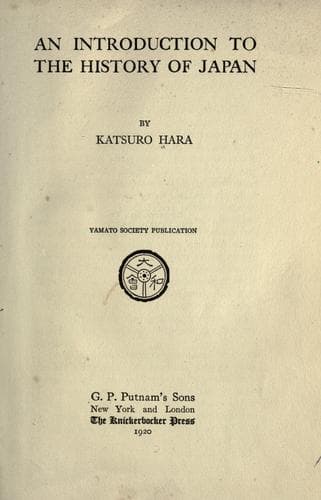
An Introduction to the History of JapanHara, Katsuro
History
An Introduction to the History of Japan
Hara, Katsuro
Japan -- History
The Emperor, who was the greatest seigneur as the owner of vast domains
and of a large number of persons, ruled at the same time over many
other seigneurs, the big freeholders of land and serf. It may be
supposed also that there might have been many minor freemen besides, who
were not rich enough to possess sufficient serfs to cultivate their
grounds for them and, therefore, were obliged to support themselves by
their own toil. Nothing positive is known, however, about them, if they
ever really existed. The right of a seigneur over his clients was almost
absolute, even the lives and chattels of his clients being at his
disposal, though the seigneur himself lay under the jurisdiction of the
Emperor. Some of the seigneurs were men of the same race as the imperial
family, their ancestors having helped in the conquest of the country.
Others were scions of the imperial family itself. It is very probable,
nevertheless, that no insignificant portion of this seigneur class was
of a blood different from that of the imperial family, having sprung
from the aboriginal race, or from immigrants other than the stock to
which the imperial family belonged.
The extent of the land over which a seigneur held sway, was in general
not very great, so that it cannot be fairly compared with any modern
Japanese province or _kuni_. Side by side with these seigneurs who were
lords of their lands, there was another class of seigneurs, who were
conspicuous, not, strictly speaking, on account of the land which they
_de facto_ possessed, but on account of their being chieftains of
certain groups of people. Some of these groups were formed by men
pursuing the same occupation. Groups thus formed were those of
fletchers, shield-makers, jewellers, mirror-makers, potters, and so
forth. Performers of religious rites, fighting-men, and scribes, too,
were grouped in this class. It must be especially noticed that groups of
men-at-arms and of scribes contained a good many foreign elements, far
more distinctly than other groups. Scribes, though their profession as a
craft was of a higher and more important nature than others, were, as
was explained in the last chapter, exclusively of foreign blood. On
account of this there was more than one set of such immigrants, and we
had in Japan several groups of scribes. As to soldiers or men-at-arms,
those who served in the first stage of the conquest of this country must
have been of the same stock as the conquering race. Later on, however,
quite a number of men who were not properly to be called Japanese, as,
for example, the Ainu and the Haito, began to be enlisted into the
service of the Emperor, and notwithstanding their difference in blood
from that of the predominant stock, their fidelity to the Emperor was
almost incomparable, and furnished many subjects for our old martial
poems.
Public-domain text, read in full here on John Shaqi.
Reviews
Reviews
No reviews yet
Be the first to share your thoughts on this work.
Elsewhere in the archive
Join the Discussion
Join the discussion
Sign in to leave a comment or review.
Sign InorCreate an account