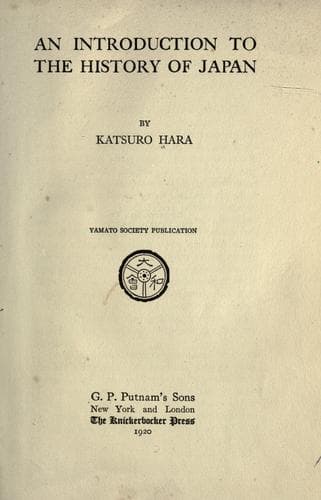
An Introduction to the History of JapanHara, Katsuro
History
An Introduction to the History of Japan
Hara, Katsuro
Japan -- History
On the other hand, to suppose that such a group was
a corporation something like the guilds of medieval Europe would be
absurd. Though the members of a guild suffered greatly under the
oppression of its master, still no relation of vassalage is recognisable
in the system. In old Japan, however, men grouped in the manner
described above belonged to the chieftain of that group, that is to say,
they were not only his subjects but his property, to be disposed of at
his free will. As to the groups which pursued a special craft, I do not
deny the existence of the practice of bartering between them. In a
society in the stage of civilisation of old Japan, no one could exist
without some sort of bartering, and the ruling hand was not so strong
and rigorous as to be able to prohibit an individual of the group from
exchanging the work of his hands with those of men of neighbouring
groups, even when the lord of the group wished contrariwise. And it must
be kept in mind that though a member of the group of a special
profession pursued that profession as his daily business, yet he must
have been engaged in agricultural work also, tilling the ground,
presumably in the midst of which his house stood. Agricultural products
thus raised could perhaps not cover all the demands of his family for
subsistence. But, on the other hand, that all the victuals they required
were supplied by barter or by distribution on the part of the chieftain
of the respective group is hardly to be imagined.
A group pursuing the same occupation was of course not the only one
allowed to pursue it, nor was their habitation limited to one special
locality. In other words, there were many groups which were engaged in
the same occupation, and those groups had their residence in different
provinces. It is not clear whether all the groups pursuing the same
craft were under the jurisdiction of a common chieftain. The fact is
certain, however, that many groups engaged in the same craft often had a
common chieftain, notwithstanding their occupying different localities.
The chieftain of a group was sometimes of the same blood as the members
of the group, as in the case where the group consisted of homogeneous
immigrants. The chieftains of immigrant craft-groups, the number of
which was very much limited in this country, belonged to this category.
Sometimes, however, the chieftain of such a craft-group was not of the
same stock as the members of the group under him, though the latter
might be of homogeneous blood. This was especially the case when a group
was that of arms-bearers composed of Ainu or Haito. These valiant people
were enlisted into a homogeneous company, but they were put under the
direction of some trustworthy leader, who was of the same racial origin
as the imperial family or who belonged to a race subjected to the
imperial rule long before. Lastly, in the case where a group was a
memorial institution, it is probable that the chieftain was nominated by
Public-domain text, read in full here on John Shaqi.
Reviews
Reviews
No reviews yet
Be the first to share your thoughts on this work.
Elsewhere in the archive
Join the Discussion
Join the discussion
Sign in to leave a comment or review.
Sign InorCreate an account