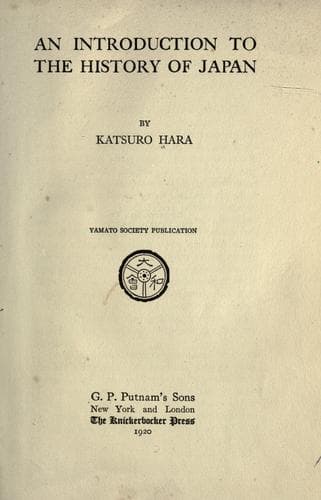
An Introduction to the History of JapanHara, Katsuro
History
An Introduction to the History of Japan
Hara, Katsuro
Japan -- History
As to the chieftains of groups, they must have been of later origin than
the landlords, for to be a virtual possessor of land only as the
consequence of being chieftain of the people who happened to occupy the
land shows that the relation between the people and the land inhabited
by them was the result of some historical development. Moreover, the
grouping of people according to their handicrafts must be a step far
advanced beyond the pristine crowding together of people of promiscuous
callings. It is also an important fact which should be taken into
consideration here again that the greater part of the craft-groups
consisted of immigrants. From all these data we may safely enough assume
that the chieftains who were at first placed at the head of a certain
group of people perhaps came over to this country simultaneously with
the predominant stock, or came from the same home at a time not very far
distant from that of the migration of the predominant stock itself, and
that they distinguished themselves by their fidelity to the emperor; in
short, these chieftains might have been mostly of the same racial origin
as the imperial family, except in the case of groups formed by
peninsular immigrants of later date. The increasing organisation of such
groups, therefore, must have led to the aggrandizement of the power of
the imperial family; but there was, of course, the same fear of a
relaxation of the blood-ties between the emperor and the chieftains akin
in blood to him.
Such are the general facts relating to the social and political life of
Japan before the seventh century. If its development had continued on
the lines described above, the ultimate result would have been the
division of the country among a large number of petty chieftains,
heterogeneous in blood and in the nature of the power which they
wielded, and with very relaxed ties between themselves and the emperor.
We can observe a similar state of things even today among several
uncivilised tribes, for example, among the natives of Formosa and in
many South Sea Islands. Japan, however, was not destined to the same
fate. How then did it come to be consolidated?
Centralisation presupposes a centre into which the surroundings may be
centralised. This centre or nucleus for centralisation may be an
individual or a corporate organism. As regards the latter, however, in
order to become a nucleus of centralisation, it must be solidly
organised, which is only possible in an advanced stage of civilisation.
For Japan in the period of which I am speaking, such a centre could
create only a very loose centralisation, which could be broken asunder
very easily. To have Japan strongly centralised, it was necessary for
her to have an individual, that is to say the Emperor, as a nucleus of
centralisation.
Public-domain text, read in full here on John Shaqi.
Reviews
Reviews
No reviews yet
Be the first to share your thoughts on this work.
Elsewhere in the archive
Join the Discussion
Join the discussion
Sign in to leave a comment or review.
Sign InorCreate an account