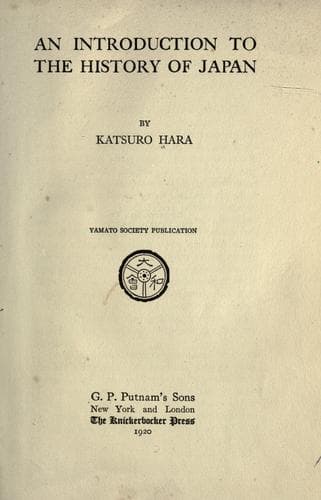
An Introduction to the History of JapanHara, Katsuro
History
An Introduction to the History of Japan
Hara, Katsuro
Japan -- History
This increase in number of _miyake_ was in itself the increase of the
wealth of the imperial family, and the increase of its power at the same
time. It is a matter of course that such growth of the imperial family
contributed largely to the increase of the imperial power itself, and
was therefore a step toward centralisation. With a family as centre,
however, a strong centralisation was impossible at a time when there was
no definite regulation concerning the succession. The law of
primogeniture had not yet been enacted. Princesses were not excluded
from the order of succession. In such an age too strong a centralisation
with the family as its nucleus, if it had been possible, could only have
been a cause of constant internal feuds. The interests of certain
members of the imperial family might have come into collision with those
of the reigning Emperor, and indeed such clashes were not rare.
Besides this weakness which was like a running sore in the process of
centralisation, there was another great drawback to the growth of the
imperial power. This was the increase in power and influence of certain
chieftains. At first there were many chieftains of nearly equal power,
and as none among them was influential enough to lord it over all the
others, it was not very difficult for the imperial family to avail
itself of the rivalry that prevailed among them and to control them
accordingly. Some families among the chieftains, however, began to grow
rich and powerful like the imperial family itself, while the greater
part of them remained more or less stationary, so that a wide gap
between the selected few and the rest as regards their influence became
perceptible. Thus five conspicuous families, those of Ohtomo, Mononobe,
Nakatomi, Abe, and Wani, first emerged from the numerous members of the
chieftain class. The family of the Soga, which was descended from
Takeshiuchi, the minister of the Empress Jingu, became afterwards very
prominent, so that only two of the former five, namely, the Ohtomo and
the Mononobe, could cope with it. Among the three which became prominent
in place of the former five, the older two continued to be engaged
exclusively in warlike business, while the third provided both ministers
and generals. The magnitude of their influence in the latter half of the
fifth century can be well imagined from the fact that the Emperor
Yuryaku complained on his death bed that his vassals' private domains
had become too extensive.
Public-domain text, read in full here on John Shaqi.
Reviews
Reviews
No reviews yet
Be the first to share your thoughts on this work.
Elsewhere in the archive
Join the Discussion
Join the discussion
Sign in to leave a comment or review.
Sign InorCreate an account