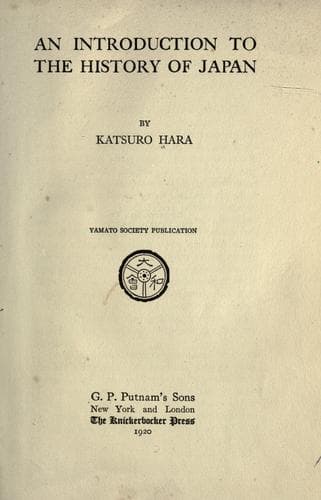
An Introduction to the History of JapanHara, Katsuro
History
An Introduction to the History of Japan
Hara, Katsuro
Japan -- History
The palaces and temples in Nara, as well as the imperial mansions and
the abodes of nobles scattered about the country, seem in a great
measure to have been solidly and magnificently built, with their roofs
covered with tiles as beforementioned. The nobles who had no permanent
residence in the city, had as their bounden duty to pay certain duty
visits, as it were, to the imperial court, and learn there how to refine
their country life by adopting the metropolitan ways of living. Some of
the household furniture used by the nobles and members of the imperial
family was bought in China. The education of the higher classes enabled
them not only to read and write the literary Chinese with ease and
fluency, but to behave correctly according to Chinese etiquette, as if
they were themselves genuine Chinese. These are the bright aspects of
the history of the Nara age. Around the metropolitan city, however, and
those aristocratic abodes in the country, swarmed the impoverished
people, utterly uneducated, receiving no benefit whatever from the
imported Chinese civilisation. Here one might perhaps ask, could not
Buddhism give them any solace at all? Not in the least. The shrewd
Buddhists, having seen that Shintoism had been strangely tenacious in
resisting the propagation of their creed notwithstanding its lack of
system and dogma, wisely invented a clever method to keep a firm hold
even on the conservative mind by identifying the patron deities of
Buddhism with the national gods of our country. It resembles in some
ways the device of the early Christian missionaries in northern Europe,
who tried to blend Teutonic mythology with Christian legend. The only
difference between them is that those missionaries did not go so far as
our Buddhist priests did. This device of the Buddhists was crowned with
complete success. By this identification Buddhism became a religion
which could be embraced without any palpable contradiction to Shintoism,
in other words, with no risk of injuring the national traditions. Nay,
it came to be considered that Shintoism was not only compatible with
Buddhism, but also subservient to its real interests. Thus we find
almost everywhere a Shinto shrine standing within the same precincts as
a Buddhist temple, the Shinto deity being regarded as the patron of the
Buddhist creed and its place of worship. This strange combination
continued to be looked upon as a matter of course until the Restoration
of Meidji, when the revival of the imperial prerogative was accompanied
by a reaction against Buddhism, and the purification of Shintoism from
its Buddhistic admixture was enthusiastically undertaken. On account of
the dubiosity of their religious character, many finely built temples
and images of exquisite art were ruthlessly demolished, much to the
regret of art connoisseurs.
Public-domain text, read in full here on John Shaqi.
Reviews
Reviews
No reviews yet
Be the first to share your thoughts on this work.
Elsewhere in the archive
Join the Discussion
Join the discussion
Sign in to leave a comment or review.
Sign InorCreate an account