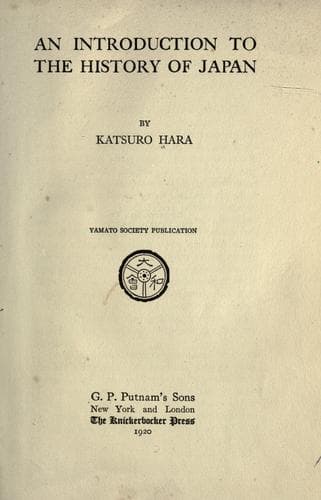
An Introduction to the History of JapanHara, Katsuro
History
An Introduction to the History of Japan
Hara, Katsuro
Japan -- History
within the family was very loose, perhaps much weaker than in the
Highland clans in Scotland. Such dissension should be attributed to the
fact that those who passed under the same family name of the Minamoto or
the Taira became soon too numerous to present a united front always,
whenever a conflict with the rival family arose. At any rate the feud
between the respective main branches of the two families was very bitter
and inveterate, covering many generations. Of the two, the Minamoto,
hardened by constant warfare with the still savage tribes in the north,
and trained by the privations unavoidable in wars, surpassed the Taira
in robustness and bravery. The Taira became, on the contrary, as the
result of close contact with the courtiers at Kyoto, more refined than
the Minamoto. Though alternately employed as generals in war as well as
instruments in intrigues, the Taira were thought by the Fujiwara to be
more docile, and therefore were more trusted than the Minamoto. This is
why the former were able to seize possession of the government earlier
than the latter. Kiyomori, the first and the last of the Taira, who was
made the highest minister of the crown, as if he were himself one of the
Fujiwara nobles, was able to reach that goal of the ambition of
courtiers, by intruding himself among them, intermingling his sons and
grandsons with the flower of the Fujiwara, and at last he made one of
his daughters the consort of the Emperor Takakura. His only distinction
as compared with the old nobles was that his personal character was too
rough and soldier-like, and the means he resorted to were too drastic
and forcible, for the over-refined members of the Fujiwara. Kiyomori had
in his quality too much of the real statesman to be an idle player in
the pageants and ceremonies of the court, and it is said that he often
committed blunders through his unseemly deportment as courtier, and
became, on that account, the laughing-stock of the Fujiwara.
Nevertheless he, like the most of the Fujiwara, could not rid himself of
the mistaken idea, that the statesman and the courtier were the same
thing, so that none could be the one without being the other. The
younger members of the family were reared up rather as courtiers than as
soldiers, trained more in playing on musical instruments, in dancing,
and in witty versification of short poems than in the use of weapons.
Public-domain text, read in full here on John Shaqi.
Reviews
Reviews
No reviews yet
Be the first to share your thoughts on this work.
Elsewhere in the archive
Join the Discussion
Join the discussion
Sign in to leave a comment or review.
Sign InorCreate an account