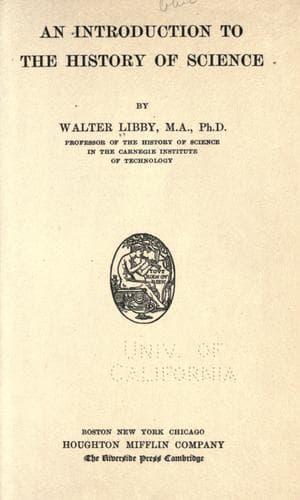
An Introduction to the History of ScienceLibby, Walter
History
An Introduction to the History of Science
Libby, Walter
Science -- History
W. W. Ford, _The Life and Work of Robert Koch_, Bulletin of the Johns
Hopkins Hospital, Dec. 1911, vol. 22.
C. A. Herter, _The Influence of Pasteur on Medical Science_, Bulletin
of the Johns Hopkins Hospital, Dec. 1903, vol. 14.
E. O. Jordan, _General Bacteriology_ (fourth edition, 1915).
Charles C. W. Judd, _The Life and Work of Lister_, Bulletin of the
Johns Hopkins Hospital, Oct. 1910, vol. 21.
Stephen Paget, _Pasteur and After Pasteur_.
W. T. Sedgwick, _Principles of Sanitary Science_.
René Vallery-Radot, _Life of Pasteur_.
CHAPTER XVII
SCIENCE AND INVENTION--LANGLEY'S AEROPLANE
In his laudation of the nineteenth century Alfred Russel Wallace
ventured to enumerate the chief inventions of that period: (1) Railways;
(2) steam navigation; (3) electric telegraphs; (4) the telephone; (5)
friction matches; (6) gas-lighting; (7) electric-lighting; (8)
photography; (9) the phonograph; (10) electric transmission of power;
(11) Röntgen rays; (12) spectrum analysis; (13) anæsthetics; (14)
antiseptic surgery. All preceding centuries--less glorious than the
nineteenth--can claim but seven or eight capital inventions: (1)
Alphabetic writing; (2) Arabic numerals; (3) the mariner's compass; (4)
printing; (5) the telescope; (6) the barometer and thermometer; (7) the
steam engine. Similarly, to the nineteenth century thirteen important
theoretical discoveries are ascribed, to the eighteenth only two, and to
the seventeenth five.
Of course the very purpose of these lists--namely, to compare the
achievements of one century with those of other centuries--inclines us
to view each invention as an isolated phenomenon, disregarding its
antecedents and its relation to contemporary inventions. Studied in its
development, steam navigation is but an application of one kind of steam
engine, and, moreover, must be viewed as a phase in the evolution of
navigation since the earliest times. Like considerations would
apply to railways, antiseptic surgery, or friction matches. The
nineteenth-century inventor of the friction match was certainly no more
ingenious (considering the means that chemistry had put at his disposal)
than many of the savages who contributed by their intelligence to
methods of producing, maintaining, and using fire. In fact, as we
approach the consideration of prehistoric times it becomes difficult to
distinguish inventions from the slow results of development--in
metallurgy, tool-making, building, pottery, war-gear, weaving, cooking,
the domestication of animals, the selection and cultivation of plants.
Moreover, it is scarcely in the category of invention that the
acquisition of alphabetic writing or the use of Arabic numerals properly
belongs.
Public-domain text, read in full here on John Shaqi.
Reviews
Reviews
No reviews yet
Be the first to share your thoughts on this work.
Elsewhere in the archive
Join the Discussion
Join the discussion
Sign in to leave a comment or review.
Sign InorCreate an account