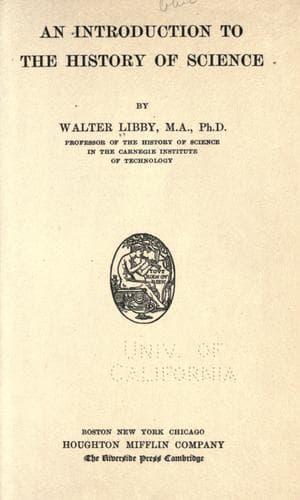
An Introduction to the History of ScienceLibby, Walter
History
An Introduction to the History of Science
Libby, Walter
Science -- History
According to John Stuart Mill, "It appears ... to be a condition of a
genuinely scientific hypothesis, that it be not destined always to
remain an hypothesis, but be of such a nature as to be either proved or
disproved by that comparison with observed facts which is termed
Verification." This statement is of value in confirming the general
distrust of _mere_ hypothesis, and in distinguishing between the
unverified and unverifiable presupposition and the legitimate assumption
which through verification may become established doctrine.
REFERENCES
J. Cox, _Beyond the Atom_, 1913 (Cambridge Manuals of Science and
Literature).
R. K. Duncan, _The New Knowledge_, 1905.
H. Poincaré, _Science and Hypothesis_.
E. Rutherford, _Radioactive Substances and their Radiations_.
F. Soddy, _The Interpretation of Radium_.
F. Soddy, _Matter and Energy_ (Home University Library).
Sir William A. Tilden, _Progress of Scientific Chemistry in our Own
Time_, 1913.
CHAPTER XIX
THE SCIENTIFIC IMAGINATION
Psychology, or the science of mental life as revealed in behavior, has
been greatly indebted to physiologists and to students of medicine in
general. Any attempt to catalogue the names of those who have approached
the study of the mind from the direction of the natural sciences is
liable to prove unsatisfactory, and a brief list is sure to entail many
important omissions. The mention of Locke, Cheselden, Hartley, Cabanis,
Young, Weber, Gall, Müller, Du Bois-Reymond, Bell, Magendie, Helmholtz,
Darwin, Lotze, Ferrier, Goltz, Munk, Mosso, Maudsley, Carpenter, Galton,
Hering, Clouston, James, Janet, Kraepelin, Flechsig, and Wundt will,
however, serve to remind us of the richness of the contribution of the
natural sciences to the so-called mental science. Indeed, physiology
would be incomplete unless it took account of the functions of the sense
organs, of the sensory and motor nerves, of the brain with its
association areas, as well as the expression of the emotions, and the
changes of function accompanying the development of the nervous system,
from the formation of the embryo till physical dissolution, and from
species of the simplest to those of the most complex organization.
Public-domain text, read in full here on John Shaqi.
Reviews
Reviews
No reviews yet
Be the first to share your thoughts on this work.
Elsewhere in the archive
Join the Discussion
Join the discussion
Sign in to leave a comment or review.
Sign InorCreate an account