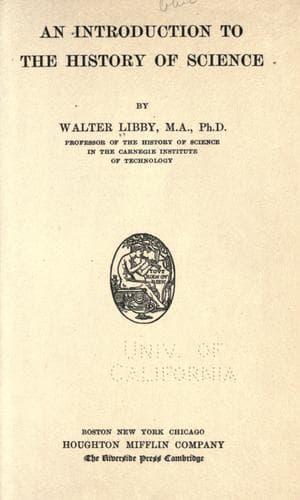
An Introduction to the History of ScienceLibby, Walter
History
An Introduction to the History of Science
Libby, Walter
Science -- History
Of course, in our system the center of attraction is the nucleus of the
sun. The mass of this body increases rapidly, as also its power of
attraction. Of the particles gravitating to it the heavier become heaped
up in the center. In falling from different heights toward this common
focus the particles cannot have such perfect equality of resistance that
no lateral movements should be set up. A general circulatory motion is
in fact established ultimately in one direction about the central mass,
which receiving new particles from the encircling current rotates in
harmony with it.
Mutual interference in the particles outside the mass of the sun
prevents all accumulation except in one plane and that takes the form of
a thin disk continuous with the sun's equator. In this circulating
vaporous disk about the sun differences of density give rise to zones
not unlike the rings of Saturn. These zones ultimately contract to form
planets, and as the planets are thrown off from the central solar mass
till an equilibrium is established between the centripetal and
centrifugal forces, so the satellites in turn are formed from the
planets. The comets are to be regarded as parts of the system, akin to
the planets, but more remote from the control of the centripetal force
of the sun. It is thus that Kant conceived the nebular hypothesis,
accounting (through the formation of the heavenly bodies from a cloudy
vapor similar to that still observable through the telescope) for the
revolution of the planets in one direction about the sun; the rotation
of sun and planets; the revolution and rotation of satellites; the
comparative densities of the heavenly bodies; the materials in the tails
of comets; the rings of Saturn, and other celestial phenomena. Newton,
finding no matter between the planets to maintain the community of their
movements, asserted that the immediate hand of God had instituted the
arrangement without the intervention of the forces of Nature. His
disciple Kant now undertook to explain an additional number of
phenomena on mechanical principles. Granted the existence of matter, he
felt capable of tracing the cosmic evolution, but at the same time he
maintained and strengthened his religious position, and did not assume
(like Democritus and Epicurus) eternal motion without a Creator or the
coming together of atoms by accident or haphazard.
Public-domain text, read in full here on John Shaqi.
Reviews
Reviews
No reviews yet
Be the first to share your thoughts on this work.
Elsewhere in the archive
Join the Discussion
Join the discussion
Sign in to leave a comment or review.
Sign InorCreate an account