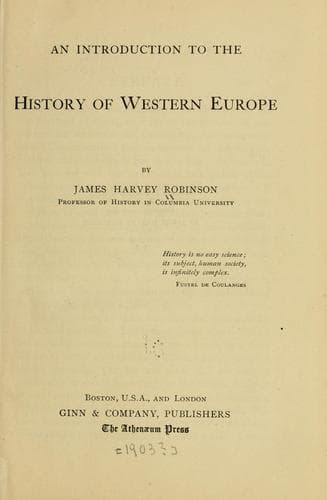
An Introduction to the History of Western EuropeRobinson, James Harvey
History
An Introduction to the History of Western Europe
Robinson, James Harvey
Europe -- History
In spite of a patched-up reconciliation with the king, Becket proceeded
to excommunicate or suspend some of the great English prelates and, as
Henry believed, was conspiring to rob his son of the crown. In a fit of
anger, Henry exclaimed among his followers, "Is there no one to avenge
me of this miserable clerk?" Unfortunately certain knights took the rash
expression literally, and Becket was murdered in Canterbury cathedral,
whither he had returned. The king had really had no wish to resort to
violence, and his sorrow and remorse when he heard of the dreadful deed,
and his terror at the consequences, were most genuine. The pope proposed
to excommunicate the king. Henry, however, made peace with the papal
legates by the solemn assertion that he had never wished the death of
Thomas and by promising to return to Canterbury all the property which
he had confiscated, to send money to aid in the capture of the Holy
Sepulcher at Jerusalem, and to undertake a crusade himself.[92]
[Sidenote: Richard the Lion-Hearted, 1189-1199.]
[Sidenote: John, 1199-1216.]
54. Henry's later years were troubled by the machinations of Philip
Augustus of France and by the quarrels and treason of his own sons, of
which some account has already been given.[93] He was followed by his
son, the picturesque Richard the Lion-Hearted, one of the most romantic
figures of the Middle Ages. He was, however, a poor ruler, who spent but
a few months of his ten years' reign in England. He died in 1199 and was
succeeded by his brother John, from all accounts one of the most
detestable persons who has ever worn a crown. His reign was,
nevertheless, a notable one in the annals of England. In the first
place, he lost a great part of the possessions of his house upon the
continent (Normandy, Brittany, Anjou, etc.); secondly, he was forced by
a revolt of his people, who refused to endure his despotism any longer,
to grant the Great Charter. The loss of his lands across the Channel has
already been described; it remains only to speak of the winning of the
Great Charter of English liberties.[94]
[Sidenote: The granting of the Great Charter, 1215.]
Public-domain text, read in full here on John Shaqi.
Reviews
Reviews
No reviews yet
Be the first to share your thoughts on this work.
Elsewhere in the archive
Join the Discussion
Join the discussion
Sign in to leave a comment or review.
Sign InorCreate an account