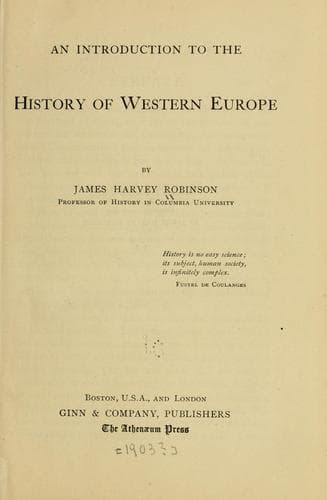
An Introduction to the History of Western EuropeRobinson, James Harvey
History
An Introduction to the History of Western Europe
Robinson, James Harvey
Europe -- History
To forbid the king to take part in the investiture was, consequently, to
rob him not only of his feudal rights but also of his authority over
many of his government officials, since bishops, and sometimes even
abbots, were often counts in all but name. Moreover, the monarch relied
upon the clergy, both in Germany and France, to counterbalance the
influence of his lay vassals, who were always trying to exalt their
power at his expense. He therefore found it necessary to take care who
got possession of the important church offices.
[Sidenote: The marriage of the clergy threatens the wealth of the
Church.]
60. Still another danger threatened the wealth and resources of the
Church. During the tenth and eleventh centuries the rule of the Church
prohibiting the clergy from marrying[104] appears to have been widely
and publicly neglected in Italy, Germany, France, and England. To the
stricter critics of the time this appeared a terrible degradation of the
clergy, who, they felt, should be unencumbered by family cares and
wholly devoted to the service of God. The question, too, had another
side. It was obvious that the property of the Church would soon be
dispersed if the clergy were allowed to marry, since they would wish to
provide for their children. Just as the feudal tenures had become
hereditary, so the church lands would become hereditary unless the
clergy were forced to remain unmarried.
[Sidenote: Buying and selling of church offices.]
Besides the feudalizing of its property and the marriage of the clergy,
there was a third great and constant source of weakness and corruption
in the Church, namely, the temptation to buy and sell church offices.
Had the duties and responsibilities of the bishops, abbots, and priests
always been arduous and exacting, and their recompense barely enough to
maintain them, there would have been little tendency to bribe those who
could bestow the appointments. But the incomes of bishoprics and abbeys
were usually considerable, sometimes very great, while the duties
attached to the office of bishop or abbot, however serious in the eyes
of the right-minded, might easily be neglected by the unscrupulous. The
revenue from a great landed estate, the distinction of high
ecclesiastical rank, and the governmental prerogatives that went with
the office, were enough to induce the members of the noblest families to
vie with each other in securing church positions. The king or prince who
possessed the right of investiture was sure of finding some one willing
to pay something for important benefices.
[Sidenote: Origin of the term simony.]
Public-domain text, read in full here on John Shaqi.
Reviews
Reviews
No reviews yet
Be the first to share your thoughts on this work.
Elsewhere in the archive
Join the Discussion
Join the discussion
Sign in to leave a comment or review.
Sign InorCreate an account