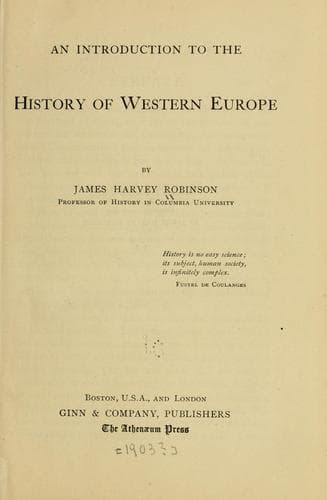
An Introduction to the History of Western EuropeRobinson, James Harvey
History
An Introduction to the History of Western Europe
Robinson, James Harvey
Europe -- History
62. The first great step toward the emancipation of the Church from the
control of the laity was taken by Nicholas II. In 1059 he issued a
remarkable decree which took the election of the head of the Church once
for all out of the hands of both the emperor and the people of Rome, and
placed it definitely and forever in the hands of the _cardinals_, who
represented the Roman clergy.[107] Obviously the object of this decree
was to preclude all lay interference, whether of the distant emperor, of
the local nobility, or of the Roman mob. The college of cardinals still
exists and still elects the pope.[108]
[Sidenote: Opposition to further reforms.]
The reform party which directed the policy of the popes had, it hoped,
freed the head of the Church from the control of worldly men by putting
his election in the hands of the Roman clergy. It now proposed to
emancipate the Church as a whole from the base entanglements of earth:
first, by strictly forbidding the married clergy to perform religious
functions and by exhorting their flocks to refuse to attend their
ministrations; and secondly, by depriving the kings and feudal lords of
their influence over the choice of the bishops and abbots, since this
influence was deemed the chief cause of worldliness among the prelates.
Naturally these last measures met with far more general opposition than
the new way of electing the pope. An attempt to expel the married clergy
from Milan led to a popular revolt, in which the pope's legate actually
found his life in danger. The decrees forbidding clergymen to receive
their lands and offices from laymen received little attention from
either the clergy or the feudal lords. The magnitude of the task which
the popes had undertaken first became fully apparent when Hildebrand
himself ascended the papal throne, in 1073, as Gregory VII.
CHAPTER XIII
THE CONFLICT BETWEEN GREGORY VII AND HENRY IV
[Sidenote: The _Dictatus_ of Gregory VII.]
63. Among the writings of Gregory VII there is a very brief statement,
called the _Dictatus_, of the powers which he believed the popes to
possess. Its chief claims are the following: The pope enjoys a unique
title; he is the only universal bishop and may depose and reinstate
other bishops or transfer them from place to place. No council of the
Church may be regarded as speaking for Christendom without his consent.
The Roman Church has never erred, nor will it err to all eternity. No
one may be considered a Catholic Christian who does not agree with the
Roman Church. No book is authoritative unless it has received the papal
sanction.
Public-domain text, read in full here on John Shaqi.
Reviews
Reviews
No reviews yet
Be the first to share your thoughts on this work.
Elsewhere in the archive
Join the Discussion
Join the discussion
Sign in to leave a comment or review.
Sign InorCreate an account