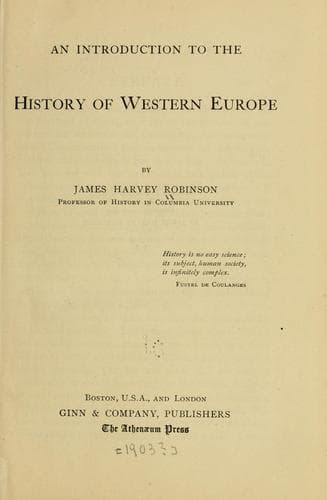
An Introduction to the History of Western EuropeRobinson, James Harvey
History
An Introduction to the History of Western Europe
Robinson, James Harvey
Europe -- History
Immediately upon his election as pope, Gregory began to put into
practice his high conception of the rôle that the spiritual head of the
world should play. He dispatched legates throughout Europe, and from
this time on these legates became a powerful instrument of government.
He warned the kings of France and England and the youthful German ruler,
Henry IV, to forsake their evil ways, to be upright and just, and obey
his admonitions. He explains, kindly but firmly, to William the
Conqueror that the papal and kingly powers are both established by God
as the greatest among the authorities of the world, just as the sun and
moon are the greatest of the heavenly bodies.[110] But the papal power
is obviously superior to the kingly, for it is responsible for it; at
the Last Day Gregory must render an account of the king as one of the
flock intrusted to his care. The king of France was warned to give up
his practice of simony, lest he be excommunicated and his subjects freed
from their oath of allegiance. All these acts of Gregory appear to have
been dictated not by worldly ambition but by a fervent conviction of
their righteousness and of his duty toward all men.
[Sidenote: Death of Henry III, 1056.]
64. Obviously Gregory's plan of reform included all the states of
western Europe, but conditions were such that the most striking conflict
took place between him and the emperor. The trouble came about in this
way. Henry III had died in 1056, leaving only his good wife Agnes and
their little son of six years to maintain the hard-fought prerogatives
of the German king in the midst of ambitious vassals such as even Otto
the Great had found it difficulty to control.
[Sidenote: Accession of Henry IV, 1065.]
In 1065 the fifteen-year-old lad was declared of age, and his lifelong
difficulties began with a great rebellion of the Saxons. They accused
the young king of having built castles in their land and of filling them
with rough soldiers who preyed upon the people. Gregory felt it his duty
to interfere. To him the Saxons appeared a people oppressed by a
heedless youth under the inspiration of evil counselors.
As one reads of Henry's difficulties and misfortunes it seems miraculous
that he was able to maintain himself as king at all. Sick at heart,
unable to trust any one, and forced to flee from his own subjects, he
writes contritely to the pope: "We have sinned against heaven and before
thee and are no longer worthy to be called thy son." But when cheered
for a moment by a victory over the rebellious Saxons, he easily forgot
his promise of obedience to the pope. He continued to associate with
counselors whom the pope had excommunicated and went on filling
important bishoprics in Germany and Italy regardless of the pope's
prohibitions.
[Sidenote: New prohibition of lay investiture.]
Public-domain text, read in full here on John Shaqi.
Reviews
Reviews
No reviews yet
Be the first to share your thoughts on this work.
Elsewhere in the archive
Join the Discussion
Join the discussion
Sign in to leave a comment or review.
Sign InorCreate an account