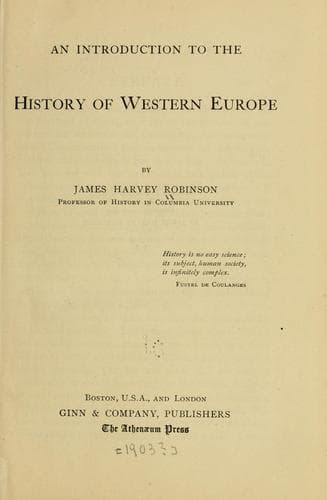
An Introduction to the History of Western EuropeRobinson, James Harvey
History
An Introduction to the History of Western Europe
Robinson, James Harvey
Europe -- History
While the pope had been guiding the affairs of the empire he had by no
means neglected to exhibit his power in other quarters, above all in
England. The monks of Canterbury had (1205) ventured to choose an
archbishop--who was at the same time their abbot--without consulting
their king, John. Their appointee hastened off to Rome to gain the
pope's confirmation, while the irritated John forced the monks to hold
another election and make his treasurer archbishop. Innocent thereupon
rejected both of those who had been elected, sent for a new deputation
of monks from Canterbury, and bade them choose Stephen Langton, a man of
great ability. John then angrily drove the monks of Canterbury out of
the kingdom. Innocent replied by placing England under the _interdict_,
that is to say, he ordered the clergy to close all the churches and
suspend all public services,--a very terrible thing to the people of the
time. John was excommunicated, and the pope threatened that unless the
king submitted to his wishes he would depose him and give his crown to
Philip Augustus of France. As Philip made haste to collect an army for
the conquest of England, John humbly submitted to the pope in 1213. He
went so far as to hand England over to Innocent III and receive it back
as a fief, thus becoming the vassal of the pope. He agreed also to send
a yearly tribute to Rome.[124]
[Sidenote: The fourth Lateran Council, 1215.]
Innocent, in spite of several setbacks, now appeared to have attained
all his ambitious ends. The emperor, Frederick II, was his protégé and,
as king of Sicily, his acknowledged vassal, as was also the king of
England. He not only asserted but also maintained his right to
interfere in all the important political affairs of the various European
countries. In 1215 a stately international congress--the fourth Lateran
Council--met in his palace. It was attended by hundreds of bishops,
abbots, and representatives of kings, princes, and towns. Its decrees
were directed against the abuses in the Church and the progress of
heresy, both of which were seriously threatening the power of the
clergy. It confirmed the election of Frederick II and excommunicated
once more the now completely discredited Otto.[125]
[Sidenote: Death of Innocent III, 1216.]
[Sidenote: Emperor Frederick II, 1212-1250.]
Public-domain text, read in full here on John Shaqi.
Reviews
Reviews
No reviews yet
Be the first to share your thoughts on this work.
Elsewhere in the archive
Join the Discussion
Join the discussion
Sign in to leave a comment or review.
Sign InorCreate an account