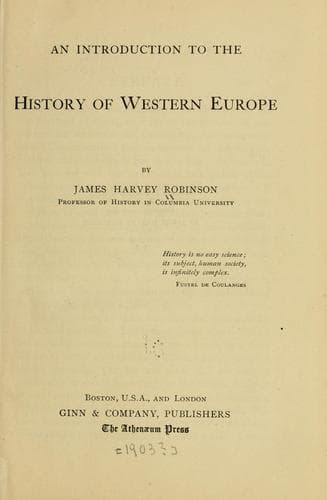
An Introduction to the History of Western EuropeRobinson, James Harvey
History
An Introduction to the History of Western Europe
Robinson, James Harvey
Europe -- History
With Frederick's death the mediæval empire may be said to have come to
an end. It is true that after a period of "fist law," as the Germans
call it, a new king, Rudolf of Hapsburg, was elected in Germany in 1273.
The German kings continued to call themselves emperors. Few of them,
however, took the trouble to go to Rome to be crowned by the pope. No
serious effort was ever made to reconquer the Italian territory for
which Otto the Great, Frederick Barbarossa, and his son and grandson had
made such serious sacrifices. Germany was hopelessly divided and its
king was no real king. He had no capital, no well-organized government.
[Sidenote: Division of Germany and Italy into small independent
states.]
By the middle of the thirteenth century it became apparent that neither
Germany nor Italy was to be converted into a strong single kingdom like
England and France. The map of Germany shows a confused group of
duchies, counties, archbishoprics, bishoprics, abbacies, and free towns,
each one of which asserted its practical independence of the weak king
and emperor.
In northern Italy each town, including a certain district about its
walls, had become an independent state, dealing with its neighbors as
with independent powers. The Italian towns were destined to become the
birthplace of our modern culture during the fourteenth and fifteenth
centuries. Venice and Florence, in spite of their small size, came to be
reckoned among the most important states of Europe. In the central part
of the peninsula the pope maintained more or less control over his
possessions, but he often failed to subdue the towns within his realms.
To the south Naples remained for some time under the French dynasty,
which the pope had called in, but the island of Sicily drifted into
Spanish hands.
CHAPTER XV
THE CRUSADES
73. Of all the events of the Middle Ages, the most romantic and
fascinating are the Crusades, the adventurous expeditions to Syria,
undertaken by kings and doughty knights with the hope of permanently
reclaiming the Holy Land from the infidel Turks. All through the twelfth
and thirteenth centuries each generation beheld at least one great army
of crusaders gathering from all parts of the West and starting toward
the Orient. Each year witnessed the departure of small bands of pilgrims
or of solitary soldiers of the cross. For two hundred years there was a
continuous stream of Europeans of every rank and station making their
way into western Asia. If they escaped the countless hazards of the
journey, they either settled in this distant land and devoted themselves
to war or commerce, or returned home, bringing with them tales of great
cities and new peoples, of skill and luxury unknown in the West.
[Sidenote: Natural temptation to overrate the importance of the
Crusades.]
Public-domain text, read in full here on John Shaqi.
Reviews
Reviews
No reviews yet
Be the first to share your thoughts on this work.
Elsewhere in the archive
Join the Discussion
Join the discussion
Sign in to leave a comment or review.
Sign InorCreate an account