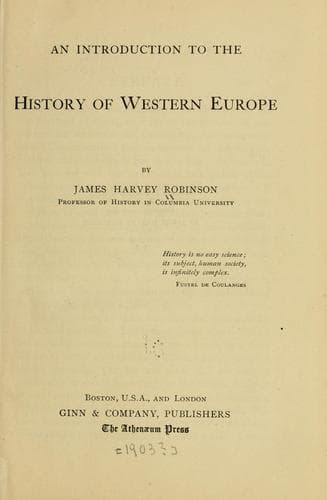
An Introduction to the History of Western EuropeRobinson, James Harvey
History
An Introduction to the History of Western Europe
Robinson, James Harvey
Europe -- History
Only a bishop could ordain new members of the clergy or degrade the old.
He alone could consecrate churches or anoint kings. He alone could
perform the sacrament of confirmation, though as priest he might
administer any of the other sacraments.[137] Aside from his purely
religious duties, he was the overseer of all the churchmen in his
diocese, including the monks.[138] He held a court where a great variety
of suits were tried. If he were a conscientious prelate, he traveled
about his diocese visiting the parish churches and the monasteries to
see if the priests did their duty and the monks behaved themselves
properly.
[Sidenote: The bishop's temporal duties.]
In addition to the oversight of his diocese, it was the bishop's
business to see to the lands and other possessions which belonged to the
bishopric. He had, moreover, to perform those governmental duties which
the king, especially in Germany, had thrown upon him, and he was
conspicuous among the monarch's counselors. Lastly, the bishop was
usually a feudal lord, with the obligations that that implied. He might
have vassals and subvassals, and often was himself a vassal, not only of
the king but also of some neighboring lord. As one reads through the
archives of a bishopric, it is hard to tell whether the bishop should be
called, first and foremost, a churchman or a feudal lord. In short, the
duties of the bishop were as manifold as those of the mediæval Church
itself.
[Sidenote: Election of the bishops.]
The reforms of Gregory VII had resulted in placing the choice of the
bishop in the hands of the cathedral _chapter_,[139] that is, the body
of clergy connected with the cathedral church. But this did not prevent
the king from suggesting the candidate, since the chapter did not
venture to proceed to an election without procuring a license from the
king. Otherwise he might have refused to invest the person they chose
with the lands and political prerogatives attached to the office.
[Illustration: Canterbury Cathedral]
[Sidenote: The parish priest and his duties.]
The lowest division of the Church was the parish. This had definite
limits, although the parishioners might vary in number from a few
families to a considerable village or an important district of a town.
At the head of the parish was the parish priest, who conducted services
in the parish church and absolved, baptized, married, and buried his
parishioners. The priests were supposed to be supported by the lands
belonging to the parish church and by the tithes. But both of these
sources of income were often in the hands of laymen or of a neighboring
monastery, while the priest received the merest pittance, scarcely
sufficient to keep soul and body together.
Public-domain text, read in full here on John Shaqi.
Reviews
Reviews
No reviews yet
Be the first to share your thoughts on this work.
Elsewhere in the archive
Join the Discussion
Join the discussion
Sign in to leave a comment or review.
Sign InorCreate an account