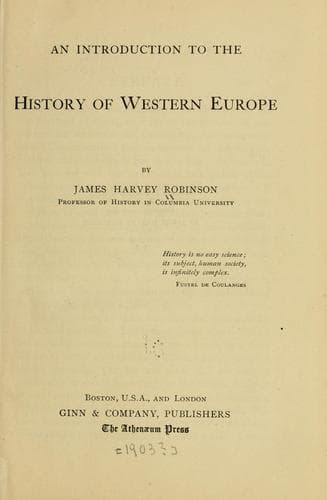
An Introduction to the History of Western EuropeRobinson, James Harvey
History
An Introduction to the History of Western Europe
Robinson, James Harvey
Europe -- History
82. The sacrament of penance is, with the Mass, of especial historical
importance. When a bishop ordained a priest, he said to him: "Receive ye
the Holy Ghost: whose soever sins ye forgive, they are forgiven them:
whose soever sins ye retain, they are retained." In this way the priest
was intrusted with the keys of the kingdom of heaven. There was no hope
of salvation for one who had fallen into mortal sin unless he
received--or at least desired and sought--the absolution of the priest.
To one who scorned the priest's ministrations the most sincere and
prayerful repentance could not by itself bring forgiveness in the eyes
of the Church. Before the priest could utter the solemn "I absolve thee
from thy sins," the sinner must have duly confessed his sins and have
expressed his vehement detestation of them and his firm resolve never
more to offend. It is clear that the priest could not pronounce judgment
unless he had been told the nature of the case. Nor would he be
justified in absolving an offender who was not truly sorry for what he
had done. Confession and penitence were, therefore, necessary
preliminaries to absolution.[143]
[Sidenote: Penance and purgatory.]
Absolution did not free the contrite sinner from all the results of his
sin. It cleared the soul of the deadly guilt which would otherwise have
been punished by everlasting suffering, but did not exempt the penitent
from temporal penalties. These might be imposed by the priest in this
world or suffered after death in the fires of purgatory, which cleansed
the soul and prepared it for heaven.
[Sidenote: Nature of penance.]
The punishment prescribed by the priest was called _penance_. This took
a great variety of forms. It might consist in fasting, repeating
prayers, visiting holy places, or abstaining from one's ordinary
amusements. A journey to the Holy Land was regarded as taking the place
of all penance. Instead, however, of requiring the penitent actually to
perform the fasts, pilgrimages, or other sacrifices imposed as penance
by the priest, the Church early permitted him to change his penance into
a contribution, to be applied to some pious enterprise, like building a
church or bridge, or caring for the poor and sick.
[Sidenote: The Mass.]
[Sidenote: Transubstantiation.]
Public-domain text, read in full here on John Shaqi.
Reviews
Reviews
No reviews yet
Be the first to share your thoughts on this work.
Elsewhere in the archive
Join the Discussion
Join the discussion
Sign in to leave a comment or review.
Sign InorCreate an account