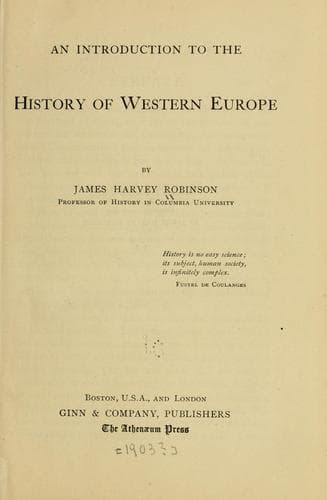
An Introduction to the History of Western EuropeRobinson, James Harvey
History
An Introduction to the History of Western Europe
Robinson, James Harvey
Europe -- History
The influence of the clergy was greatly enhanced by the fact that they
alone were educated. For six or seven centuries after the overthrow of
the Roman government in the West, very few outside of the clergy ever
dreamed of studying or even of learning to read and write. Even in the
thirteenth century an offender who wished to prove that he belonged to
the clergy, in order that he might be tried by a church court, had only
to show that he could read a single line; for it was assumed by the
judges that no one unconnected with the Church could read at all.[145]
It was therefore inevitable that almost all the books should be written
by priests and monks and that the clergy should become the ruling power
in all intellectual, artistic, and literary matters,--the chief
guardians and promoters of civilization. Moreover, the civil government
was forced to rely upon churchmen to write out the public documents and
proclamations. The priests and monks held the pen for the king.
Representatives of the clergy sat in the king's councils and acted as
his ministers; in fact, the conduct of the government largely devolved
upon them.[146]
[Sidenote: Offices in the Church open to all classes.]
The offices in the Church were open to all ranks of men, and many of the
popes themselves sprang from the humblest classes. The Church thus
constantly recruited its ranks with fresh blood. No one held an office
simply because his father had held it before him, as was the case in the
civil government.
[Sidenote: Lea's description of the mediæval Church.]
The man who entered the service of the Church "was released from the
distraction of family cares and the seduction of family ties. The Church
was his country and his home and its interests were his own. The moral,
intellectual, and physical forces, which throughout the laity were
divided between the claims of patriotism, the selfish struggle for
advancement, the provision for wife and children, were in the Church
consecrated to a common end, in the success of which all might hope to
share, while all were assured of the necessities of existence, and were
relieved of anxiety as to the future." The Church was thus "an army
encamped on the soil of Christendom, with its outposts everywhere,
subject to the most efficient discipline, animated with a common
purpose, every soldier panoplied with inviolability and armed with the
tremendous weapons which slew the soul" (Lea).
General Reading.--CUTTS, _Parish Priests and their People_ (E. &
J.B. Young, $3.00). PRÉVOST, _L'Église et les Campagnes au Moyen
Âge_ (Paris, $1.50).
CHAPTER XVII
HERESY AND THE FRIARS
[Sidenote: The question of the character of the mediæval clergy.]
Public-domain text, read in full here on John Shaqi.
Reviews
Reviews
No reviews yet
Be the first to share your thoughts on this work.
Elsewhere in the archive
Join the Discussion
Join the discussion
Sign in to leave a comment or review.
Sign InorCreate an account