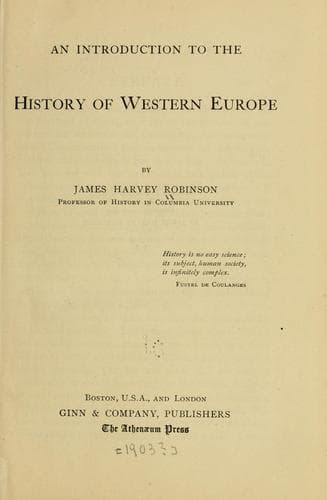
An Introduction to the History of Western EuropeRobinson, James Harvey
History
An Introduction to the History of Western Europe
Robinson, James Harvey
Europe -- History
Gregory VII imagined that the reason for the existence of bad clergymen
was that the kings and feudal lords forced their favorites into the
offices of the Church. The root of the difficulty lay, however, in the
wealth and power of the Church itself. It would have needed saints
always to exercise righteously the tremendous powers which the clergy
had acquired, and to resist the temptations to which they were
subjected. When we consider the position of a rich prelate, it is not
surprising that corruption abounded. The offices of the Church offered
the same possibilities of money-making that civil offices, especially
those in the great American cities, offer to the mere schemer to-day.
The descriptions of some of the churchmen of the twelfth and thirteenth
centuries remind us far more of the professional politician than of a
modern clergyman, whether Catholic or Protestant.
[Sidenote: The chief forms of corruption in the Church.]
85. At least a brief description of the more notorious forms of
corruption among the clergy will be necessary to an understanding of the
various heresies or revolts against the Church. These began seriously to
threaten its power in the twelfth century and culminated in the
successful Protestant revolt of the sixteenth. The vices of the clergy
serve to account also for the appearance of the begging monks, the
Franciscans and Dominicans, and to explain the need of the great reform
which they undertook in the thirteenth century.
[Sidenote: Simony.]
[Sidenote: The worldly and immoral lives of many bishops and abbots.]
In the first place, there was simony, a disease so deep-seated and
persistent that Innocent III declared it incurable. This has already
been described in an earlier chapter. Even boys were made bishops and
abbots through the influence of their friends and relatives. Wealthy
bishoprics and monasteries were considered by feudal lords an admirable
means of support for their younger sons, since the eldest born usually
inherited the fief. The life led by bishops and abbots was often merely
that of a feudal prince. If a prelate had a taste for fighting, he
organized military expeditions for conquest or to satisfy a grudge
against a neighbor, exactly as if he belonged to the bellicose laity of
the period.
[Sidenote: Corruption in the ecclesiastical courts.]
Public-domain text, read in full here on John Shaqi.
Reviews
Reviews
No reviews yet
Be the first to share your thoughts on this work.
Elsewhere in the archive
Join the Discussion
Join the discussion
Sign in to leave a comment or review.
Sign InorCreate an account