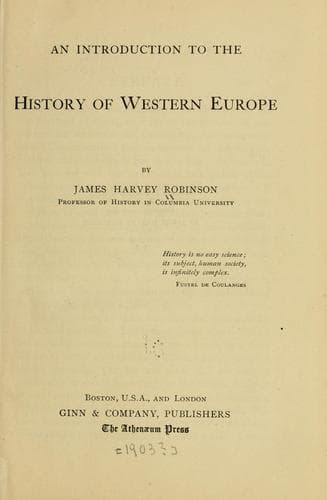
An Introduction to the History of Western EuropeRobinson, James Harvey
History
An Introduction to the History of Western Europe
Robinson, James Harvey
Europe -- History
The northern merchants dealt mainly with Venice and brought their wares
across the Brenner Pass and down the Rhine, or sent them by sea to be
exchanged in Flanders. By the thirteenth century important centers of
trade had come into being, some of which are still among the great
commercial towns of the world. Hamburg, Lübeck, and Bremen carried on
active trade with the countries on the Baltic and with England. Augsburg
and Nuremberg, in the south of Germany, became important on account of
their situation on the line of trade between Italy and the North.
Bruges and Ghent sent their manufactures everywhere. English commerce
was relatively unimportant as yet compared with that of the great ports
of the Mediterranean.
[Sidenote: Restrictions on trade.]
[Sidenote: Idea of a 'just' price.]
95. A word must be said of the numerous and almost incredible obstacles
in the way of commerce in the Middle Ages. There was very little of that
freedom which we now regard as essential to successful business. Our
wholesale dealers would have been considered an abomination in the
Middle Ages. Those who bought up a quantity of a commodity in order to
sell it at a high rate were called by the ugly name of _forestallers_.
It was universally believed that everything had a "just" price, which
was merely enough to cover the cost of the materials used in its
manufacture and remunerate the maker for the work he had put upon it. It
was considered outrageous to sell a thing for more than the just price,
no matter how anxious the purchaser might be to obtain it. Every
manufacturer was required to keep a shop in which he offered at retail
all that he made. Those who lived near a town were permitted to sell
their products in the market place within the walls on condition that
they sold directly to the consumers. They might not dispose of their
whole stock to one dealer, for fear that if he had all there was of a
commodity he might raise the price above a just one.
[Sidenote: Payment of interest on money forbidden.]
Akin to these prejudices against wholesale trade was that against
interest. Money was believed to be a dead and sterile thing, and no one
had a right to demand any return for lending it. Interest was wicked,
since it was exacted by those who took advantage of the embarrassments
of others. Usury, as the taking of even the most moderate and reasonable
rate of interest was then called, was strenuously forbidden by the laws
of the Church. We find church councils ordering that impenitent usurers
should be refused Christian burial and have their wills annulled. So
money-lending, necessary to all great commercial and industrial
undertakings, was left to the Jews, from whom Christian conduct was not
expected.
[Sidenote: The Jews as money-lenders.]
Public-domain text, read in full here on John Shaqi.
Reviews
Reviews
No reviews yet
Be the first to share your thoughts on this work.
Elsewhere in the archive
Join the Discussion
Join the discussion
Sign in to leave a comment or review.
Sign InorCreate an account