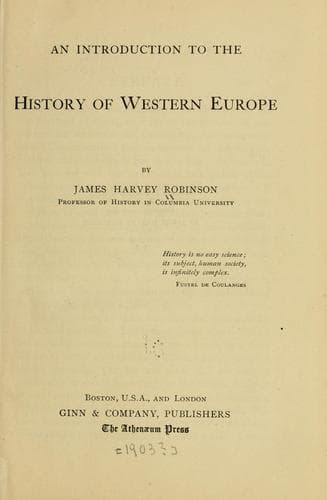
An Introduction to the History of Western EuropeRobinson, James Harvey
History
An Introduction to the History of Western Europe
Robinson, James Harvey
Europe -- History
In the latter part of the twelfth century the romances of King Arthur
and his Knights of the Round Table begin to appear. These enjoyed great
popularity in all western Europe for centuries, and they are by no means
forgotten yet. Arthur, of whose historical existence no one can be quite
sure, was supposed to have been king of Britain shortly after the Saxons
gained a foothold in the island. In other long poems of the time,
Alexander the Great, Cæsar, and other ancient worthies appear as heroes.
The absolute disregard of historical facts and the tendency to represent
the warriors of Troy and Rome as mediæval knights, show the inability of
the mediæval mind to understand that the past could have been different
from the present. All these romances are full of picturesque adventures
and present a vivid picture of the valor and loyalty of the true knight,
as well as of his ruthlessness and contempt for human life.[165]
[Sidenote: The _fabliaux_ and the fables.]
Besides the long and elaborate epics, like _Roland_, and the romances in
verse and prose, there were numberless short stories in verse (the
_fabliaux_), which usually dealt with the incidents of everyday life,
especially with the comical ones. Then there were the fables, the most
famous of which are the stories of Reynard the Fox, which were satires
upon the customs of the time, particularly the weaknesses of the priests
and monks.
[Sidenote: The troubadours.]
100. Turning now to southern France, the beautiful songs of the
troubadours, which were the glory of the Provençal tongue, reveal a gay
and polished society at the courts of the numerous feudal princes. The
rulers not merely protected and encouraged the poets; they aspired to be
poets themselves and to enter the ranks of the troubadours, as the
composers of these elegant verses were called. These songs were always
sung to an accompaniment on some instrument, usually the lute. Those who
merely sang them, without being themselves poets, were called
_jongleurs_. The troubadours and jongleurs traveled from court to court,
not only in France, but north into Germany and south into Italy,
carrying with them the southern French poetry and customs. We have few
examples of Provençal before the year 1100, but from that time on, for
two centuries, countless songs were written, and many of the troubadours
enjoyed an international reputation. The terrible Albigensian crusade
brought misery and death into the sprightly circles which had gathered
about the count of Toulouse and others who had treated the heretics too
leniently. But the literary critic traces signs of decline in the
Provençal verse even before this disaster.[166]
[Sidenote: Chivalry.]
Public-domain text, read in full here on John Shaqi.
Reviews
Reviews
No reviews yet
Be the first to share your thoughts on this work.
Elsewhere in the archive
Join the Discussion
Join the discussion
Sign in to leave a comment or review.
Sign InorCreate an account