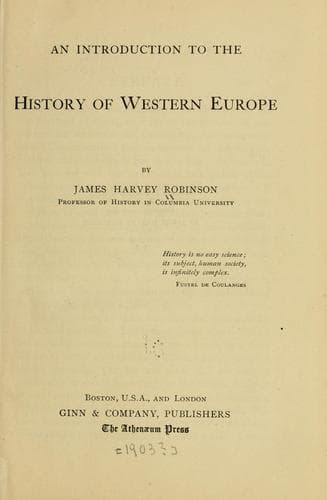
An Introduction to the History of Western EuropeRobinson, James Harvey
History
An Introduction to the History of Western Europe
Robinson, James Harvey
Europe -- History
So we find that even when scholasticism was most popular in the
universities, there were keen-sighted scientists who recommended the
modern scientific method of discovering truth. This does not consist in
discussing, according to the rules of logic, what a Greek philosopher
said hundreds of years ago, but in the patient observation of things
about us.
* * * * *
[Sidenote: Review of the great changes between the break-up of the Roman
Empire in the west and the end of the thirteenth century.]
We have now traversed somewhat over one half of the long period of
fifteen hundred years which separates Europe of to-day from the
disintegrating Roman Empire of the fifth century. The eight hundred
years which lie between the century of Alaric, Attila, Leo the Great,
and Clovis, and that of Innocent III, St. Louis, and Edward I, witnessed
momentous changes, quite as important as any that have occurred since.
[Sidenote: The 'dark ages.']
It is true that it seemed at first as if the barbarous Goths, Franks,
Vandals, and Burgundians were bringing nothing but turmoil and
distraction. Even the strong hand of Charlemagne curbed the unruly
elements for only a moment; then the discord of his grandsons and the
incursions of Northmen, Hungarians, Slavs, and Saracens plunged western
Europe once more into the same anarchy and ignorance through which it
had passed in the seventh and eighth centuries.
Two hundred years and more elapsed after Charlemagne's death before we
can begin once more to note signs of progress. While we know little of
the eleventh century, and while even its most distinguished writers are
forgotten by all save the student of the period, it was undoubtedly a
time of preparation for the brilliant twelfth century--for Abelard and
St. Bernard, for the lawyers, poets, architects, and philosophers who
seem to come suddenly upon the scene.
[Sidenote: The twelfth and thirteenth centuries a period of rapid
advance.]
The Middle Ages may therefore be divided into two fairly distinct and
quite different periods. The centuries prior to the age of Gregory VII
and of William the Conqueror may, on account of their disorder and
ignorance, be properly called the "dark ages," although they beheld some
important stages in the transformation of Europe. The later Middle Ages,
on the contrary, were a time of rapid and unmistakable progress in
almost every line of human endeavor. Indeed by the end of the thirteenth
century a great part of those changes were well under way which serve to
make modern Europe so different from the condition of western Europe
under the Roman Empire. The most striking of these are the following.
[Sidenote: Appearance of national states.]
Public-domain text, read in full here on John Shaqi.
Reviews
Reviews
No reviews yet
Be the first to share your thoughts on this work.
Elsewhere in the archive
Join the Discussion
Join the discussion
Sign in to leave a comment or review.
Sign InorCreate an account