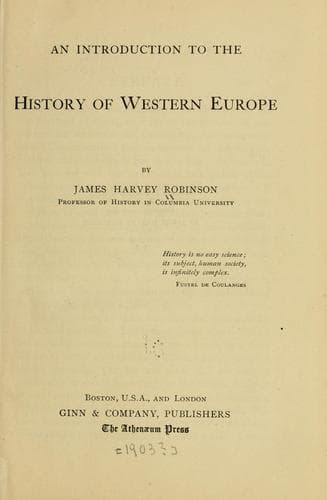
An Introduction to the History of Western EuropeRobinson, James Harvey
History
An Introduction to the History of Western Europe
Robinson, James Harvey
Europe -- History
General Reading.--For the political history of this period, LODGE,
_Close of the Middle Ages_ (The Macmillan Company, $1.75), is the
best work, although rather dry and cumbered with names which might
have been omitted. For the general history of France, see in
addition to ADAMS, _Growth of the French Nation_ (The Macmillan
Company, $1.25), DURUY, _A History of France_ (T.Y. Crowell,
$2.00). The economic history of England is to be found in the works
mentioned at the end of Chapter XVIII. The following collections of
documents furnish illustrative material in abundance: LEE,
_Source-book of English History_ (Holt, $2.00); COLBY, _Selections
from the Sources of English History_, (Longmans, Green & Co.,
$1.50); ADAMS & STEPHENS, _Select Documents of English
Constitutional History_ (The Macmillan Company, $2.25); KENDALL,
_Source Book of English History_ (The Macmillan Company, 80 cents).
CHAPTER XXI
THE POPES AND THE COUNCILS
[Sidenote: The problem of the relation of church and state.]
112. The influence which the Church and its head exercised over the
civil government in the Middle Ages was due largely to the absence of
strong, efficient rulers who could count upon the support of a large
body of prosperous and loyal subjects. So long as the feudal anarchy
continued, the Church endeavored to supply the deficiencies of the
restless and ignorant princes by striving to maintain order, administer
justice, protect the weak, and encourage learning. So soon, however, as
the modern state began to develop, difficulties arose. The clergy
naturally clung to the powers and privileges which they had long
enjoyed, and which they believed to be rightly theirs. On the other
hand, the state, so soon as it felt itself able to manage its own
affairs, protect its subjects, and provide for their worldly interests,
was less and less inclined to tolerate the interference of the clergy
and their head, the pope. Educated laymen were becoming more and more
common, and the king was no longer obliged to rely upon the assistance
of the clergy in conducting his government. It was natural that he
should look with disfavor upon their privileges, which put them upon a
different footing from the great mass of his subjects, and upon their
wealth, which he would deem excessive and dangerous to his power. This
situation raised the fundamental problem of the proper relation of
church and state, upon which Europe has been working ever since the
fourteenth century and has not completely solved yet.
[Sidenote: Edward I and Philip the Fair attempt to tax the clergy.]
Public-domain text, read in full here on John Shaqi.
Reviews
Reviews
No reviews yet
Be the first to share your thoughts on this work.
Elsewhere in the archive
Join the Discussion
Join the discussion
Sign in to leave a comment or review.
Sign InorCreate an account