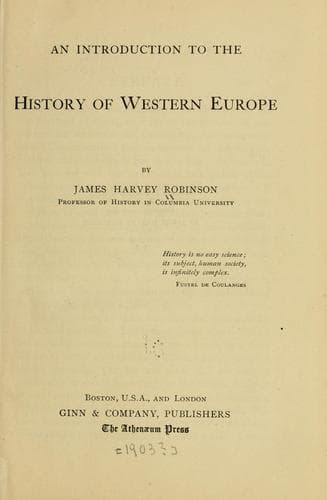
An Introduction to the History of Western EuropeRobinson, James Harvey
History
An Introduction to the History of Western Europe
Robinson, James Harvey
Europe -- History
Boniface was, however, very soon to realize that even if Christendom
regarded Rome as its religious center, the nations would not accept him
as their political head. When he dispatched an obnoxious prelate to
Philip the Fair, ordering him to free the count of Flanders whom he was
holding prisoner, the king declared the harsh language of the papal
envoy to be high treason and sent one of his lawyers to the pope to
demand that the messenger be degraded and punished.
[Sidenote: The Estates General of 1302.]
Philip was surrounded by a body of lawyers, and it would seem that they,
rather than the king, were the real rulers of France. They had, through
their study of Roman law, learned to admire the absolute power exercised
by the Roman emperor. To them the civil government was supreme, and they
urged the king to punish what they regarded as the insolent conduct of
the pope. Before taking any action against the head of the Church,
Philip called together the representatives of his people, including not
only the clergy and the nobility but the people of the towns as well.
The Estates General, after hearing a statement of the case from one of
Philip's lawyers, agreed to support their monarch.
[Sidenote: Nogaret insults Boniface VIII.]
[Sidenote: Death of Boniface, 1303.]
Nogaret, one of the chief legal advisers of the king, undertook to face
the pope. He collected a little troop of soldiers in Italy and marched
against Boniface, who was sojourning at Anagni, where his predecessors
had excommunicated two emperors, Frederick Barbarossa and Frederick II.
As Boniface, in his turn, was preparing solemnly to proclaim the king of
France an outcast from the Church, Nogaret penetrated into the papal
palace with his soldiers and heaped insults upon the helpless but
defiant old man. The townspeople forced Nogaret to leave the next day,
but Boniface's spirit was broken and he soon died at Rome.
[Sidenote: Clement V, 1305-1314, and his subservience to Philip the
Fair.]
[Sidenote: The popes take up their residence at Avignon.]
Public-domain text, read in full here on John Shaqi.
Reviews
Reviews
No reviews yet
Be the first to share your thoughts on this work.
Elsewhere in the archive
Join the Discussion
Join the discussion
Sign in to leave a comment or review.
Sign InorCreate an account