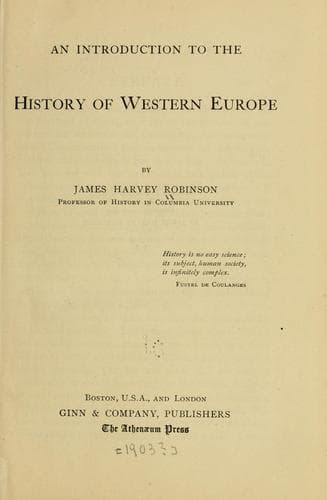
An Introduction to the History of Western EuropeRobinson, James Harvey
History
An Introduction to the History of Western Europe
Robinson, James Harvey
Europe -- History
Many of the church offices, such as those of the bishops and abbots,
insured a more than ample revenue to their holders. It was natural,
therefore, that the pope, in his endeavor to increase his income, should
have tried to bring as many of these appointments as he could into his
own hands. He did this by reserving to himself the filling of certain
benefices so soon as they should become vacant. He then chose some one
to whom he wished to do a favor and promised him the benefice upon the
death of the one then holding it. Men appointed in this way were called
_provisors_ and were extremely unpopular. They were very often
foreigners, and it was suspected that they had obtained these positions
from the pope simply for the sake of the revenue, and had no intention
whatever of performing the duties connected with them.
[Sidenote: Statute of provisors, 1352.]
The papal exactions met with the greatest opposition in England because
the popes were thought to favor France, with which country the English
were at war. A law was passed by Parliament in 1352 ordering that all
who procured appointments from the pope should be outlawed, that any one
might injure such offenders at will, and that the injured should have no
redress, since they were enemies of the king and his realm.[202] This
and similar laws failed, however, to prevent the pope from filling
English benefices to the advantage of himself and his courtiers. The
English king was unable to keep the money of his realm from flowing to
Avignon on one pretext or another. It was declared by the Good
Parliament, held in 1376, that the taxes levied by the pope in England
were five times those raised by the king.
[Sidenote: John Wycliffe.]
The most famous and conspicuous critic of the pope and of the policy of
the Roman Church at this time was John Wycliffe, a teacher at Oxford. He
was born about 1320; but we know little of him before 1366, when Urban V
demanded that England should pay the tribute promised by King John when
he became the pope's vassal.[203] Parliament declared that John had no
right to bind the people without their consent, and Wycliffe began his
career of opposition to the papacy by trying to prove that John's
compact was void. About ten years later we find the pope issuing bulls
against the teachings of Wycliffe, who had begun to assert that the
state might appropriate the property of the Church if it was misused,
and that the pope had no authority except as he acted according to the
Gospels. Soon Wycliffe went further and boldly attacked the papacy
itself, as well as indulgences, pilgrimages, and the worship of the
saints; finally he even denied the truth of the doctrine of
transubstantiation.
[Sidenote: Wycliffe's 'simple priests.']
Public-domain text, read in full here on John Shaqi.
Reviews
Reviews
No reviews yet
Be the first to share your thoughts on this work.
Elsewhere in the archive
Join the Discussion
Join the discussion
Sign in to leave a comment or review.
Sign InorCreate an account