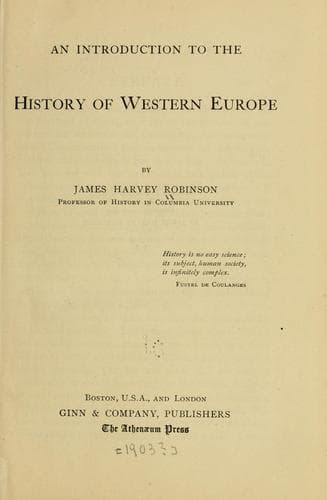
An Introduction to the History of Western EuropeRobinson, James Harvey
History
An Introduction to the History of Western Europe
Robinson, James Harvey
Europe -- History
The new pope, however, soon showed that he had no idea of returning to
Avignon. He treated the cardinals with harshness and proposed a stern
reformation of their habits. The cardinals speedily wearied of this
treatment; they retired to the neighboring Anagni and declared that they
had been frightened by the Roman mob into selecting the obnoxious Urban.
They then elected a new pope, who took the title of Clement VII,
returned to Avignon, and established his court there. Urban, although
deserted by his cardinals, had no intention of yielding and proceeded to
create twenty-eight new cardinals.
[Sidenote: The Great Schism.]
This double election was the beginning of the _Great Schism_, which was
to last for forty years and expose the papacy to new attacks on every
side. There had been many anti-popes in earlier centuries, set up
usually by the emperors; but there had ordinarily been little question
as to who was really the legitimate pope. In the present case Europe was
seriously in doubt, for it was difficult to decide whether the election
of Urban had really been forced and was consequently invalid as the
cardinals claimed. No one, therefore, could be perfectly sure which of
the rival popes was the real successor of St. Peter. There were now two
colleges of cardinals whose very existence depended upon the exercise of
their right of choosing the pope. It was natural that Italy should
support Urban VI, while France as naturally obeyed Clement VII; England,
hostile to France, accepted Urban; Scotland, hostile to England,
supported Clement.
[Sidenote: The Church divided within itself and the consequences.]
Each of two men, with seemingly equal right, now claimed to be Christ's
vicar on earth; each proposed to enjoy to the full the vast prerogatives
of the head of Christendom, and each denounced, and attempted to depose,
the other. The schism in the headship of the Church naturally extended
to the bishoprics and abbeys, and everywhere there were rival prelates,
each of whom could claim that he had been duly confirmed by one pope or
the other. All this produced an unprecedented scandal in the Church. It
emphasized all the abuses among the clergy and gave free rein to those
who were inclined to denounce the many evils which had been pointed out
by Wycliffe and his followers. The condition was, in fact, intolerable
and gave rise to widespread discussion, not only of the means by which
the schism might be healed, but of the nature and justification of the
papacy itself. The discussion which arose during these forty years of
uncertainty did much to prepare the mind of western Europe for the
Protestant revolt in the sixteenth century.
[Sidenote: Idea of the supremacy of a general council.]
Public-domain text, read in full here on John Shaqi.
Reviews
Reviews
No reviews yet
Be the first to share your thoughts on this work.
Elsewhere in the archive
Join the Discussion
Join the discussion
Sign in to leave a comment or review.
Sign InorCreate an account