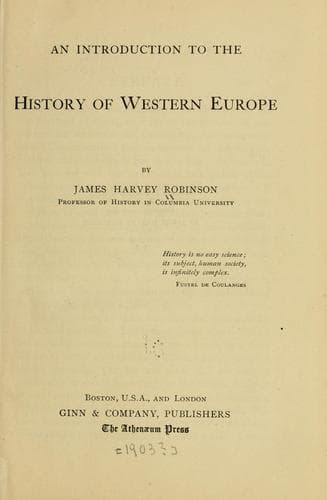
An Introduction to the History of Western EuropeRobinson, James Harvey
History
An Introduction to the History of Western Europe
Robinson, James Harvey
Europe -- History
It is hard for us to imagine the obstacles which confronted Petrarch and
the scholars of the early Renaissance. They possessed no good editions
of the Roman and Greek authors, in which the correct wording had been
determined by a careful comparison of all the known ancient copies. They
considered themselves fortunate to secure a single manuscript of even
the best known authors, and they could have no assurance that it was not
full of mistakes. Indeed, the texts were so corrupted by the
carelessness of the copyists that Petrarch declares that if Cicero or
Livy should return and stumblingly read his own writings, he would
promptly pronounce them the work of another, perhaps a barbarian.
[Sidenote: Petrarch's European reputation and influence.]
Petrarch enjoyed an unrivaled influence throughout western Europe, akin
to that of Erasmus and Voltaire in later times. He was in constant
communication with scholars, not only in Italy, but in the countries
beyond the Alps. From his numerous letters which have been preserved, a
great deal may be learned of the intellectual life of the time.[224]
[Sidenote: Petrarch has no sympathy with the popular studies of his
time.]
It is clear that he not only promoted the new study of the Roman
writers, but that he also did much to discredit the learning which was
popular in the universities. He refused to include the works of the
great scholastic writers of the thirteenth century in his library. Like
Roger Bacon he was disgusted by the reverence in which the bad
translations of Aristotle were held. As for the popular study of logic,
Petrarch declared that it was good enough for boys, but that nothing
irritated him more than to find a person of mature years devoting
himself to the subject.
[Sidenote: Contrast between Petrarch's and Dante's attitude toward their
mother tongue.]
While Petrarch is far better known for his beautiful Italian verses than
for his long Latin poems, histories, and essays, he did not share
Dante's confidence in the dignity of their mother tongue. He even
depreciates his Italian sonnets as mere popular trifles written in his
youth. It was not unnatural that he and those in whom he aroused an
enthusiasm for Latin literature should look scornfully upon Italian. It
seemed to them a crude form of speech, good enough perhaps for the
common people and for the transaction of the daily business of life, but
immeasurably inferior to the language in which their predecessors, the
Roman poets and prose writers, had written. The Italians, it must be
remembered, felt the same pride in Latin literature that we feel in the
works of Chaucer and Shakespeare. The Italian scholars of the fourteenth
and fifteenth centuries merely turned back to their own earlier national
literature for their models, and tried their best to imitate the
language and style of its masters.
[Sidenote: The humanists.]
Public-domain text, read in full here on John Shaqi.
Reviews
Reviews
No reviews yet
Be the first to share your thoughts on this work.
Elsewhere in the archive
Join the Discussion
Join the discussion
Sign in to leave a comment or review.
Sign InorCreate an account