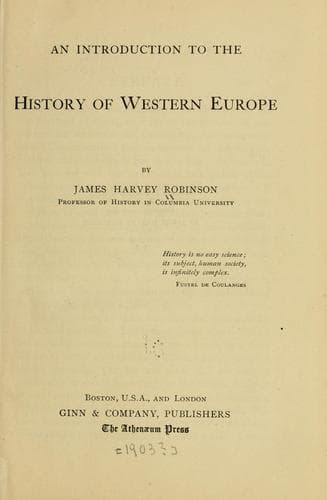
An Introduction to the History of Western EuropeRobinson, James Harvey
History
An Introduction to the History of Western Europe
Robinson, James Harvey
Europe -- History
The humanists of the fourteenth century ordinarily knew no Greek. Some
knowledge of that language lingered in the West all through the Middle
Ages, but we hear of no one attempting to read Plato, Demosthenes,
Æschylus, or even Homer, and these authors were scarcely ever found in
the libraries. Petrarch and his followers were naturally much interested
in the constant references to Greek literature which occur in Cicero and
Horace, both of whom freely recognized their debt to Athens. Shortly
after Petrarch's death the city of Florence called to its university a
professor of Greek, Chrysoloras from Constantinople.
[Sidenote: Revival of Greek studies in Italy.]
[Sidenote: Chrysoloras in Florence.]
A young Florentine law student, Leonardo Bruni, tells us of a dialogue
which he had with himself when he heard of the coming of Chrysoloras.
"Art thou not neglecting thy best interests if thou failest now to get
an insight into Homer, Plato, Demosthenes, and the other great poets,
philosophers, and orators of whom they are telling such wonderful
things? Thou, too, mightest commune with them and imbue thyself with
their wisdom. Wouldst thou let the golden opportunity slip? For seven
hundred years no one in Italy has known Greek literature, and yet we
agree that all language comes from the Greeks. How greatly would
familiarity with that language advantage thee in promoting thy knowledge
and in the mere increase of thy pleasure? There are teachers of Roman
law to be found everywhere, and thou wilt never want an opportunity to
continue that study, but there is but one teacher of Greek, and if he
escapes thee there will be no one from whom thou canst learn."
[Sidenote: The knowledge of Greek becomes common in Europe.]
Many students took advantage of the opportunity to study Greek, and
Chrysoloras prepared the first modern Greek grammar for their use.
Before long the Greek classics became as well known as the Latin.
Italians even went to Constantinople to learn the language; and the
diplomatic negotiations which the Eastern Church carried on with the
Western, with the hope of gaining help against the Turks, brought some
Greek scholars to Italy. In 1423 an Italian scholar arrived at Venice
with no less than two hundred and thirty-eight Greek books, thus
transplanting a whole literature to a new and fruitful soil.[226] Greek
as well as Latin books were carefully copied and edited, and beautiful
libraries were established by the Medici, the duke of Urbino, and Pope
Nicholas V, who founded the great library of the Vatican,[227] still one
of the most important collections of books in the world.
[Sidenote: Advantages of printing with movable types.]
Public-domain text, read in full here on John Shaqi.
Reviews
Reviews
No reviews yet
Be the first to share your thoughts on this work.
Elsewhere in the archive
Join the Discussion
Join the discussion
Sign in to leave a comment or review.
Sign InorCreate an account