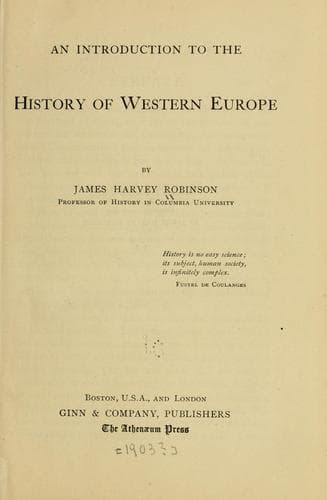
An Introduction to the History of Western EuropeRobinson, James Harvey
History
An Introduction to the History of Western Europe
Robinson, James Harvey
Europe -- History
Florence was the great center of artistic activity during the fifteenth
century. The greatest sculptors and almost all of the most famous
painters and architects of the time either were natives of Florence or
did their best work there. During the first half of the century
sculpture again took the lead. The bronze doors of the baptistery at
Florence by Ghiberti, which were completed about 1450, are among the
very best products of Renaissance sculpture. Michael Angelo declared
them worthy to be the doors of paradise. A comparison of them with the
doors of the cathedral of Pisa, which date from the end of the twelfth
century, furnishes a striking illustration of the change that had taken
place. A contemporary of Ghiberti, Luca della Robbia (1400-1482), is
celebrated for his beautiful reliefs in glazed baked clay and in marble,
of which many may be seen in Florence.
[Illustration: BRONZE DOORS OF THE CATHEDRAL AT PISA
(TWELFTH CENTURY)]
[Illustration: GHIBERTI'S DOORS AT FLORENCE]
[Illustration: Relief by Luca della Robbia]
One of the best known painters of the first half of the fifteenth
century, Fra[236] Angelico, was a monk. His frescoes on the walls of the
monastery of San Marco (and elsewhere) reflect a love of beauty and a
cheerful piety, in striking contrast to the fiery zeal of
Savonarola,[237] who, later in the century, went forth from this same
monastery to denounce the vanities of the art-loving Florentines.[238]
[Sidenote: Rome becomes the center of artistic activity.]
126. Florence reached the height of its preëminence as an art center
during the reign of Lorenzo the Magnificent, who was an ardent patron of
all the arts. With his death (1492), and the subsequent brief but
overwhelming influence of Savonarola, this preëminence passed to Rome,
which was fast becoming one of the great capitals of Europe. The
art-loving popes, Julius II and Leo X,[239] took pains to secure the
services of the most distinguished artists and architects of the time in
the building and adornment of St. Peter's and the Vatican, i.e., the
papal church and palace.
[Sidenote: The church of St. Peter.]
The idea of the dome as the central feature of a church, which appealed
so strongly to the architects of the Renaissance, reached its highest
realization in rebuilding the ancient church of St. Peter. The task was
begun in the fifteenth century; in 1506 it was taken up by Pope Julius
II with his usual energy, and it was continued all through the sixteenth
century and well into the seventeenth, under the direction of a
succession of the most famous artist-architects of the time, including
Raphael and Michael Angelo. The plan was changed repeatedly, but in its
final form the building is a Latin cross surmounted by a great dome, one
hundred and thirty-eight feet in diameter. The dimensions and
proportions of this greatest of all churches never fail to impress the
beholder with something like awe.
[Sidenote: Height of Renaissance art.]
Public-domain text, read in full here on John Shaqi.
Reviews
Reviews
No reviews yet
Be the first to share your thoughts on this work.
Elsewhere in the archive
Join the Discussion
Join the discussion
Sign in to leave a comment or review.
Sign InorCreate an account