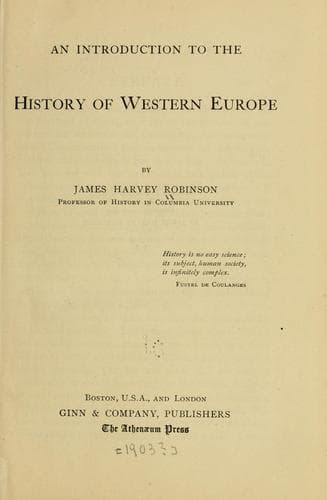
An Introduction to the History of Western EuropeRobinson, James Harvey
History
An Introduction to the History of Western Europe
Robinson, James Harvey
Europe -- History
It was naturally a great shock to men to have it suggested that their
dwelling place, instead of being God's greatest work to which He had
subordinated everything, was but a tiny speck in comparison to the whole
universe, and its sun but one of an innumerable host of similar bodies,
each of which might have its particular family of planets revolving
about it. Theologians, both Protestant and Catholic, declared the
statements of Copernicus foolish and wicked and contrary to the
teachings of the Bible. He was prudent enough to defer the publication
of his great work until just before his death; he thus escaped any
persecution to which his discovery might have subjected him.
[Sidenote: Miscellaneous inventions.]
In addition to the various forms of progress of which we have spoken,
the fourteenth and fifteenth centuries witnessed the invention or wide
application of a considerable number of practical devices which were
unknown to the Greeks and Romans. Examples of these are, besides
printing, the compass, gunpowder, spectacles, and a method of not merely
softening but of thoroughly melting iron so that it could be cast.
[Sidenote: The fourteenth and fifteenth centuries not merely a period of
revival.]
The period of which we have been speaking was, in short, by no means
merely distinguished for the revival of classical learning. It was not
simply a re-birth of the ancient knowledge and art, but a time during
which Europe laid the foundations for a development essentially
different from that of the ancient world and for achievements undreamed
of by Aristotle or Pliny.
Public-domain text, read in full here on John Shaqi.
Reviews
Reviews
No reviews yet
Be the first to share your thoughts on this work.
Elsewhere in the archive
Join the Discussion
Join the discussion
Sign in to leave a comment or review.
Sign InorCreate an account