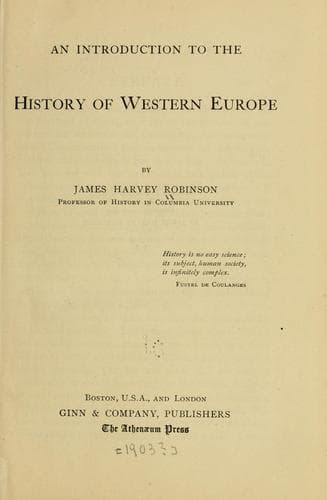
An Introduction to the History of Western EuropeRobinson, James Harvey
History
An Introduction to the History of Western Europe
Robinson, James Harvey
Europe -- History
For the invention of printing see DE VINNE, _The Invention of
Printing_, unfortunately out of print, and BLADES, _Pentateuch of
Printing_ (London, $4.75). Also PUTNAM, _Books and their Makers
during the Middle Ages_, Vol. I (G.P. Putnam's Sons, $2.50).
CHAPTER XXIII
EUROPE AT THE OPENING OF THE SIXTEENTH CENTURY
129. Two events took place in the early sixteenth century which
fundamentally influenced the history of Europe. (1) By a series of royal
marriages a great part of western Europe was brought under the control
of a single ruler, Emperor Charles V. He inherited Burgundy, Spain,
portions of Italy, and the Austrian territories; and, in 1519, he was
chosen emperor. There had been no such dominion as his in Europe since
the time of Charlemagne. Within its bounds lay Vienna, Brussels, Madrid,
Palermo, Naples, Milan, even the city of Mexico. Its creation and the
struggles which accompanied its dissolution form one of the most
important chapters in the history of modern Europe. (2) Just at the time
that Charles was assuming the responsibilities that his vast domains
brought with them, the first successful revolt against the mediæval
Church was beginning. This was to result in the disruption of the Church
and the establishment of two great religious parties, the Catholic and
the Protestant, which have endured down to the present time. The purpose
of the present chapter is to describe the origin, extent, and character
of the empire of Charles V, and to prepare the reader to grasp the
_political_ import of the Protestant revolt.
Before mentioning the family alliances which led to the consolidation of
such tremendous political power in the hands of one person, it will be
necessary, first, to note the rise of the house of Hapsburg to which
Charles belonged, and secondly, to account for the appearance in
European affairs of Spain, which has hitherto scarcely come into our
story.
[Sidenote: Reasons why the German kings failed to establish a strong
state.]
The German kings had failed to create a strong kingdom such as those
over which Louis XI of France and Henry VII of England ruled. Their fine
title of "emperor" had made them a great deal of trouble, as we have
seen.[249] Their attempts to keep Italy as well as Germany under their
rule, and the alliance of the mighty Bishop of Rome with their enemies
had well-nigh ruined them. Their position was further weakened by their
failure to render their office strictly hereditary. Although the
emperors were often succeeded by their sons, each new emperor had to be
_elected_, and those great vassals who controlled the election naturally
took care to bind the candidate by solemn promises not to interfere with
their privileges and independence. The result was that, after the
downfall of the Hohenstaufens, Germany fell apart into a great number of
practically independent states, of which none were very large and some
were extremely small.
Public-domain text, read in full here on John Shaqi.
Reviews
Reviews
No reviews yet
Be the first to share your thoughts on this work.
Elsewhere in the archive
Join the Discussion
Join the discussion
Sign in to leave a comment or review.
Sign InorCreate an account