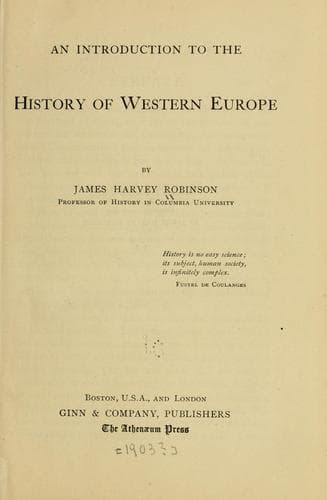
An Introduction to the History of Western EuropeRobinson, James Harvey
History
An Introduction to the History of Western Europe
Robinson, James Harvey
Europe -- History
Charles VIII of France (1483-1498) possessed little of the practical
sagacity of his father, Louis XI. He dreamed of a mighty expedition
against the Turks and of the conquest of Constantinople. As the first
step he determined to lead an army into Italy and assert his claim,
inherited from his father, to the kingdom of Naples, which was in the
hands of the house of Aragon.[258] While Italy had everything to lose by
permitting a powerful monarch to get a foothold in the South, there was
no probability that the various little states into which the peninsula
was divided would lay aside their perpetual animosities and combine
against the invader. On the contrary, Charles VIII was urged by some of
the Italians themselves to come.
[Sidenote: Savonarola and Charles VIII.]
Had Lorenzo the Magnificent still been alive, he might have organized a
league to oppose the French king, but he had died in 1492, two years
before Charles started. Lorenzo's sons failed to maintain the influence
over the people of Florence which their father had enjoyed; and the
leadership of the city fell into the hands of the Dominican friar,
Savonarola, whose fervid preaching attracted and held for a time the
attention of the fickle Florentine populace. He believed himself to be a
prophet, and proclaimed that God was about to scourge Italy for its
iniquities, and that men should flee before His wrath by renouncing
their lives of sin and pleasure.
When Savonarola heard of the French invasion, it appeared to him that
this was indeed the looked-for scourge of God, which might afflict, but
would also purify, the Church. His prophecies seemed to be fulfilled,
and his listeners were stricken with terror. As Charles approached
Florence, the people rose in revolt against the Medici, sacked their
palaces, and drove out the three sons of Lorenzo. Savonarola became the
chief figure in the new republic which was established. Charles was
admitted into Florence, but his ugly, insignificant figure disappointed
the Florentines. They soon made it clear to him that they would not
regard him in any sense as a conqueror, and would oppose a prolonged
occupation by the French. Savonarola said to him: "The people are
afflicted by your stay in Florence, and you waste your time. God has
called you to renew His Church. Go forth to your high calling lest God
visit you in His wrath and choose another instrument in your stead to
carry out His designs." So, after a week's stay, the French army left
Florence and proceeded on its southward journey.
[Sidenote: The popes since the Great Schism.]
Public-domain text, read in full here on John Shaqi.
Reviews
Reviews
No reviews yet
Be the first to share your thoughts on this work.
Elsewhere in the archive
Join the Discussion
Join the discussion
Sign in to leave a comment or review.
Sign InorCreate an account